An official website of the United States government
Here's how you know
Official websites use .gov
A .gov website belongs to an official government organization in the United States.
Secure .gov websites use HTTPS
A lock (
) or https:// means you’ve safely connected to the .gov website. Share sensitive information only on official, secure websites.
Report on heating and cooling air-distribution ducts that are insulated, installed close to the ceiling in a vented attic and covered with attic insulation to minimize energy loss.
Guide that illustrates how and when to encapsulate ductwork in unconditioned attics, increasing the R-value of duct insulation, mitigating condensation issues, and reducing air leakage.
Case study describing a stand-off furring strategy that minimizes the physical connections to each existing wall stud, uses spray foam to encapsulate existing siding materials (including lead paint), and creates a vented rain screen assembly to promote drying.
Case study describing a 4,763 ft2 certified Passive House that achieved HERS 27 without PV through the construction of R-54 walls that use ICF plus fiberglass cavity insulation, an R-100 vented attic, extensive air sealing and flashing, triple-pane windows, ductless heat pumps, and solar hot water.
High-density sidewall cavity insulation can be a major comfort and savings boost. It saves energy by slowing both conductive and convective losses, but only if the right things are done and done right. This always requires site-specific thinking.
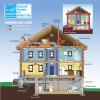
Information guide describing how to apply a whole-house approach to home improvement with energy efficiency upgrades, improved indoor air quality, and increased comfort.
Presentation describing the challenges of insulating an existing basement, presented to the Building America residential energy-efficiency stakeholder meeting.
Case study describing the elimination of excessive humidity in the attic of a multi-floor, single-family home that was causing condensation and water damage along the roof and eaves.