



Scope
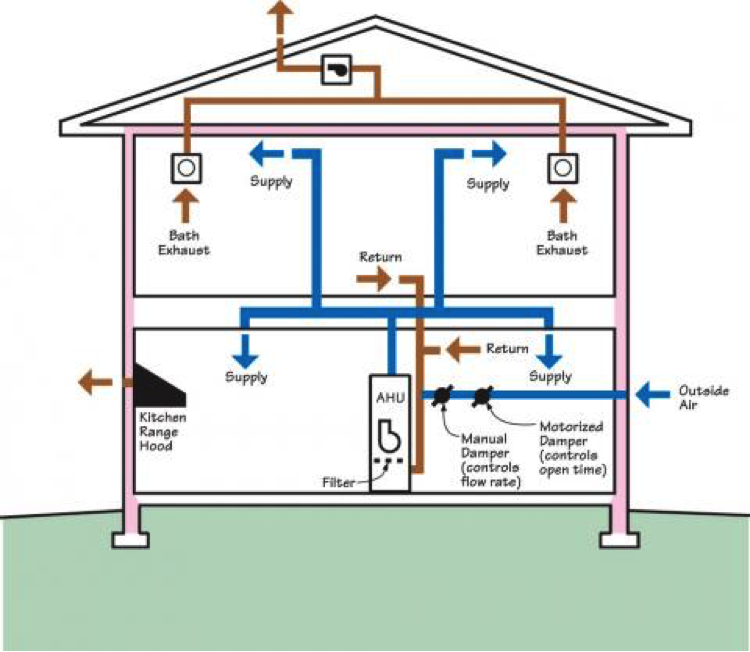
When an outdoor air inlet is ducted to the return side of the HVAC system's central air handler
- Install a motorized damper that can close the air intake.
- Install controls to provide intermittent fresh air based on a timer.
- Set the timer to meet desired or code-mandated ventilation requirements.
See the Compliance Tab for links to related codes and standards and voluntary federal energy-efficiency program requirements.
Description
In a home that has a balanced ventilation system that uses central-fan-integrated supply ventilation, a heat recovery ventilator (HRV), or an energy recovery ventilator (ERV), fresh air is brought into the home from a ventilation air inlet located on the exterior of the home (often in a roof soffit or porch roof, see the guide Ventilation Air Inlet Locations). If the outside air inlet is ducted to the return side of the central air handler, the duct should not be allowed to remain open at all times. Over-ventilation can unnecessarily increase energy use and can increase indoor humidity in humid climates. The volume and duration of fresh air intake periods should be controlled by a motorized damper that is controlled electronically to automatically provide intermittent fresh air. The damper can be controlled with a timer that is set by the HVAC installer to meet desired or code-mandated ventilation requirements, for example, the ventilation minimum determined using ASHRAE Standard 62.2-2010/2013 (The U.S. DOE offers the RED CalcTM tool to aid contractors with these calculations).
See manufacturers’ instructions for installing and setting the timer, damper, and controls. Some ERV and HRV models come with an integral motorized damper to prevent airflow when the HRV or ERV fan motor is not operating.
The timer can be used to coordinate periods of fresh air intake with operation of an exhaust fan operating within the home to provide balanced ventilation, so that the home does not become overpressurized. For more information, see the guide Whole-House Ventilation Strategies for New Homes.
The electronic controls can also be set to coordinate operation with the central air handler fan by cutting back on fan-only run time during hours when the desired amount of ventilation run time has already been met by the HVAC fan while it is operating to meet heating or cooling demand. See guide [Rater F 7.5] ECM/ICM Air Handler Fans.
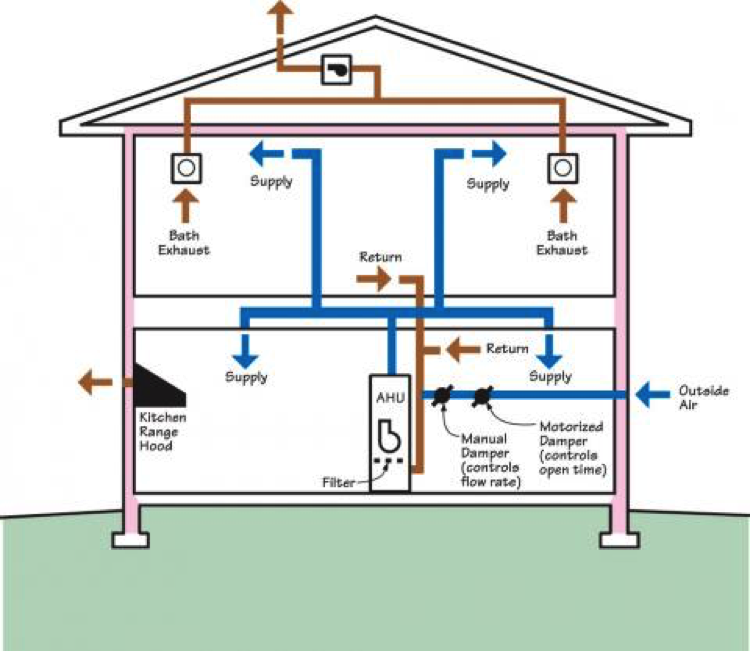
See Figure 1 for one example of a whole-house ventilation system that incorporates a central fan integrated ventilation system with a fresh air intake that is ducted directly to the return side of the air handler. Electronic controls operate the motorized damper to balance the amount of air brought into the home through the fresh air intake with exhaust fans to provide adequate ventilation air to meet the requirements of ASHRAE 62.2.
Ensuring Success
The home energy rater should verify that any fresh air intake connected to the return side of the HVAC system has a damper that is electronically controlled to provide timered ventilation and to close when not in use.
Region
Mechanically controlled dampers limit ventilation to prevent over-ventilation in humid or extreme temperature conditions.
Compliance
Retrofit
Scope
Verify that any new or existing fresh air intake to the return side of the HVAC central air handler has an electronically controlled damper.
If the project will involve working in the attic, see the assessment guide, Pre-Retrofit Assessment of Attics, Ceilings, and Roofs.
For more on supply ventilation, see the U.S. Department of Energy’s Standard Work Specifications on Supply Ventilation and Whole-House Ventilation Strategies for New Homes.
See the Scope tab for additional job specifications.
Description
If the home currently has no Whole-House Ventilation system, such as a heat recovery ventilator (HRV), energy recovery ventilator (ERV), or fresh air intake ducted to the central air handler fan, then fresh air ventilation can be provided by adding an outdoor air intake that is ducted to the return side of the HVAC system’s central air handler. This air intake should be equipped with an electronically controlled damper that will open the intake at intervals in conjunction with the air handler to provide timer-controlled ventilation that meets code requirements, as described in the Description tab.
More Info
References and Resources
*For non-dated media, such as websites, the date listed is the date accessed.
Contributors to this Guide
The following authors and organizations contributed to the content in this Guide.
Pacific Northwest National Laboratory
Questions? Comments? Contact our webmaster.