An official website of the United States government
Here's how you know
Official websites use .gov
A .gov website belongs to an official government organization in the United States.
Secure .gov websites use HTTPS
A lock (
) or https:// means you’ve safely connected to the .gov website. Share sensitive information only on official, secure websites.
Report about development of effective strategies to reduce the overall building energy use in line with Building America goals in this modestly priced market rate project.
Research study exploring a test method measuring air leakage between units through common surfaces and air infiltration across exterior, noncommon surfaces of the enclosure.
Report exploring feasibility of designing prescriptive retrofit measure packages for typical Chicago region multifamily buildings in order to achieve 25% source energy savings.
Research study documenting market-ready energy solutions to improve the efficiency of new affordable housing in the marine climate of Washington State.
This report will review, and summarize the current state of understanding and research into enclosures with higher thermal resistance, so-called “High-R Enclosures.” Recommendations are provided for further research.
Case study describing a wall and window retrofit of a 1940s kit home in Kalamazoo MI that included adding 1 inch of rigid polyisocyanurate insulation and low-e storm windows while replacing vinyl siding on the home.
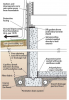
Report describing how to construct a frost protected shallow foundation (FPSF) as a practical alternative to a deeper, more-costly foundation in cold regions with seasonal ground freezing and the potential for frost heave.
Research study determining how well high performance envelope and innovative cooling system interact to cost effectively reduce cooling energy use in this hot-dry climate.
Report identifying housing characteristics and energy use for fifteen single-family housing types and specifies measure packages that provide an optimum level of energy savings based on a BEopt analysis.
Report evaluating the renovation of a 5,800-ft2, multiuse facility located in St. Petersburg, on the west coast of central Florida, in the hot-humid climate.
Report describing how modification of model specifications to include guidance on energy efficiency measures can create a greater level of consistency in executing energy efficiency retrofit measures across the multiple regions where a developer may work.
Report following the evolution of the construction quality process from its development for new homes to its application construction of a HPH with enhanced specifications, and its application in a crawlspace renovation.
Article from RMI on how climate change is leading to an increase in critical extreme heat hours and what smart building strategies can be taken to mitigate some of these effects including paint color and insulation.
Report describing a study using parametric computer simulations of 112 single-family and 63 multi-family residential building prototypes to quantify the contributions of building components such as roofs, walls, windows, infiltration, outside air, lighting, equipment, and people to the aggregate...
Case study describing a wall and window retrofit of a 1950s bungaloo home in Jackson MS that included adding 1 inch of rigid XPS insulation while replacing aluminum siding with vinyl siding and replacing the original windows with triple-pane windows.
Case study describing a wall and window retrofit of a 1970s cedar-sided home in Bellingham WA that included adding 2 inches of cork insulation while replacing the existing cedar siding and replacing the double-pane windows with triple-pane windows.
Report presenting the process of a residential retrofit project for houses in the states of Florida and Alabama, including findings at the time of reporting and highlights of the first home to meet the target HERS Index of 70.