
What this tool does

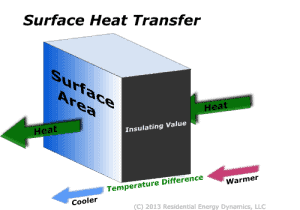
Illustration of surface heat transfer, showing that the insulating value across the surface area determines the temperature difference of heat passing through.
Illustration of surface heat transfer (Image courtesy of R. Karg)

This tool is most often used to find heat transfer through a surface, but because it is a solve-all tool, you may solve for any one of the five values.

Calculated values

  • Heat transfer; or
  • Temperature difference; or
  • R-value; or
  • Time interval; or
  • Area.

Tips

  • Clicking the label for any input or result will cause a popup help box to appear. This help box includes the allowed and normal values (for inputs).
  • Because this is a solve-all tool, you may find a result for any one of the five values. Click the radio button to the left of the value label to solve for that value. When you check a radio button to solve for a value, the color of the label changes from black to blue.
  • This tool is most often used to solve for “Heat transfer”, the last of the five values.
  • With this tool you can calculate annual heat loss/gain through a surface by entering “1 day” for the time and then entering the number of heating degree days for the temperature difference. You will receive a warning message indicating that your temperature difference input is outside the normal range, but you may proceed with the calculation.

Background

It is probably easiest to think of heat transfer through a three-dimensional object, like a house window, as being characterized by conduction only. However, heat transfer through building parts is usually a combination of conduction, convection, and radiation. The part that each of these plays is represented by the rated R-value of the building part, for example, the complex heat transfer through fiberglass insulation is represented by an R-value of 3.2 per inch (RSI of 0.564).

This RED Calc tool is based on one of the two basic equations used for sizing heating and cooling systems for dwellings. The other equation calculates hourly heat loss or gain attributed to air leakage.

Disclaimer

This content is a work created with funding provided by the United States Department of Energy under Contract no DE-AC05-076RL01830 for the operation of Pacific Northwest National Laboratory. The information and guidance provided by Pacific Northwest National Laboratory (PNNL) in the content are intended solely for educational purposes only and do not constitute formal training or certification. It is provided with the explicit understanding that neither the United States Government nor the United States Department of Energy, nor the Contractor, nor any or their employees, nor any jurisdiction or organization that has cooperated in the development of these materials, makes any warranty, express or implied, or assumes any legal liability or responsibility for the accuracy, completeness, or usefulness or any information, apparatus, product, software, or process disclosed, or represents that its use would not infringe privately owned rights. Reference herein to any specific commercial product, process, or service by trade name, trademark, manufacturer, or otherwise does not constitute or imply its endorsement, recommendation, or favoring by the United States Government or any agency thereof, or Battelle Memorial Institute. The views and opinions of authors expressed herein do not necessarily state or reflect those of the United States Government or any agency thereof. Viewers assumes full responsibility for all actions that they may take from information provided in this content including ensuring the safety, code compliance, and proper functionality of any products they choose to install. Installation and use of such products should be performed in accordance with local regulations and manufacturer instructions.