An official website of the United States government
Here's how you know
Official websites use .gov
A .gov website belongs to an official government organization in the United States.
Secure .gov websites use HTTPS
A lock (
) or https:// means you’ve safely connected to the .gov website. Share sensitive information only on official, secure websites.
This tool, along with a cardboard box and a digital manometer, allows you to accurately measure exhaust airflow at a grille. This custom-made airflow measurement device can be made on site to accommodate tight fitting spaces or exhaust fan grilles that are too large for other measurement methods.
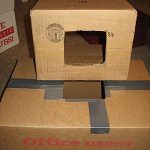
Boxes used for airflow measurements (Image courtesy of R. Karg)Clicking the label for any input or result will cause a popup help box to appear. This help box includes the allowed and normal values (for inputs).
This box will work in a manner similar to the Exhaust Fan Flow Meter® manufactured by the Energy Conservatory. However, this home-made box does not have a readily adjustable opening. The photograph above shows two boxes made for measuring exhaust fan airflow with the RED Calc Box Airflow Tool.
Do not attempt to use this RED Calc tool or the cardboard box for supply fan airflow or at supply registers.
Making and Using the Box
It is recommended that this device be used only for exhaust flows between 10 and 200 CFM (5 and 100 L/s).
The box must be tight at all joints with a known hole size, usually a rectangle.
The area of the opening you cut in the box should not be more than 50 percent of the area of that surface. “…the size of the hole [should not be] greater than half the size of the box in each direction and the distance from the hole to the grille [should be] at least as large as the larger dimension of the hole. (RESNET 804.1.2, see references section below.)
You can reduce the opening size with duct tape.
Install the hose attached to your digital manometer in a corner of the box that is away from the opening you cut in the box. The end of the hose should not protrude into the box more than 1/2 inch. Use tape to hold the hose in place.
Adjust the opening size in the box so that the pressure difference is between 1 and 8 pascals (0.008 and 0.040 iwc). Four to 5 pascals gives the best accuracy (0.016 to 0.020 iwc).
The open side of the box must be positioned so that it is tight against the surface around the grille so that all the air entering the grille of the duct or exhaust fan flows through the hole in the box.
Disclaimer
This content is a work created with funding provided by the United States Department of Energy under Contract no DE-AC05-076RL01830 for the operation of Pacific Northwest National Laboratory. The information and guidance provided by Pacific Northwest National Laboratory (PNNL) in the content are intended solely for educational purposes only and do not constitute formal training or certification. It is provided with the explicit understanding that neither the United States Government nor the United States Department of Energy, nor the Contractor, nor any or their employees, nor any jurisdiction or organization that has cooperated in the development of these materials, makes any warranty, express or implied, or assumes any legal liability or responsibility for the accuracy, completeness, or usefulness or any information, apparatus, product, software, or process disclosed, or represents that its use would not infringe privately owned rights. Reference herein to any specific commercial product, process, or service by trade name, trademark, manufacturer, or otherwise does not constitute or imply its endorsement, recommendation, or favoring by the United States Government or any agency thereof, or Battelle Memorial Institute. The views and opinions of authors expressed herein do not necessarily state or reflect those of the United States Government or any agency thereof. Viewers assumes full responsibility for all actions that they may take from information provided in this content including ensuring the safety, code compliance, and proper functionality of any products they choose to install. Installation and use of such products should be performed in accordance with local regulations and manufacturer instructions.