



What this tool does
The Depressurization Analysis “solve all” tool allows you to solve for “Building leakage @ 50Pa” (DTL), “Exhaust flow” of exhausting appliances, or “Depressurization” (combustion appliance depressurization limit).
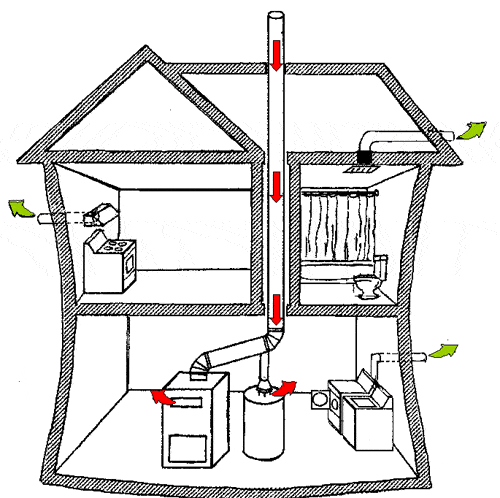
The primary purpose of this tool is to allow you to determine if vented combustion appliances will vent properly from a house while all the appliances that exhaust air (bathroom and kitchen exhaust fans, clothes dryers, etc.) are operating.
Calculated values
- Depressurization – negative pressure created by the operation of exhaust fans and other appliances that exhaust air.
- Building leakage @ 50Pa – sometimes referred to as the Depressurization Tightness Limit or DTL.
- Exhaust flow – fans and other appliances that exhaust air, such as clothes dryers.
Tips
- Clicking the label for any input or result will cause a popup help box to appear. This help box includes the allowed and normal values (for inputs).
- This is a “solve-all” tool. Select the radio button to the left of the label for which you wish to solve. This label will turn to blue and the input box will disappear.
- The most significant result you can obtain from this tool is the “Building leakage @ 50 Pa”, often referred to as the Depressurization Tightness Limit (DTL). Knowing the DTL before weatherization can be vital in planning for ventilation and knowing if existing combustion appliances will need to be replaced. A number of weatherization programs use this calculated DTL value as a planning/analysis threshold for weatherization work.
- The tighter a weatherization crew makes a house (lower and lower CFM50), the greater the magnitude of the negative pressure created by a given total CFM of the exhaust appliances.
- All input values must be entered as positive numbers.
- Some users of this tool have reported good results when using it to determine the flow of an exhaust appliance. For example, they have used the Depressurization Analysis tool to find the exhaust flow of a kitchen range hood with the following procedure:
- Set the Depressurization Analysis tool to solve for “Exhaust Flow”.
- Set up the house in blower-door-test condition.
- Perform a whole-building blower door test to determine the CFM50 of the house. Enter this value in the Depressurization Analysis tool in the “Building leakage @ 50Pa” input box. Let’s assume this value is 1405 CFM50.
- With the blower door off and plugged, turn on the kitchen range hood fan and measure the negative house-to-outdoor pressure created by the fan. Enter this negative pressure (as a positive number) in the “Depressurization” input box of the Depressurization Analysis tool. Let’s assume this value is -5 pascals. The tool will solve for the “Exhaust flow” of the kitchen range hood. The range hood Exhaust flow result is 300 CFM (141 L/s).
- In order to verify this value, use your blower door to create the same Exhaust flow rate, for this example, 300 CFM. This known blower door flow should create the same house depressurization as the kitchen range hood fan did, for this example, -5 pascals.
- Note: Accuracy of this procedure increases on calm days (lack of wind) and when the depressurization created by the exhaust appliance is significant. We recommend turning on the Uncertainty feature for the tool (see “Preferences” in the tools menus) when using this procedure.
Background
| Combustion Appliance Type | Maximum Depressurization Limit (Pascals) |
|---|---|
| Appliances with manufacturer-certified negative pressure tolerance rating | The manufacturer-certified negative pressure tolerance rating |
| Atmospheric-burner water heater only (Category I, natural draft), open-combustion appliance, orphaned and not installed in a code-compliant chimney size | -2 |
| Atmospheric-burner water heater (Category I, natural draft) and common-vented atmospheric-burner furnace (Category I, natural draft), open-combustion appliances | -3 |
| Atmospheric burner water heater (Category I, natural draft) and common-vented Category I fan-assisted furnace, open-combustion appliances | -5 |
| Atmospheric-burner water heater (Category I, natural draft) installed as a stand-alone unit vented into a code-compliant chimney | -5 |
| Gas furnace or boiler, Category I or Category I fan-assisted, open-combustion appliances | -5 |
| Oil or gas unit with power burner, low- or high-static pressure burner, open-combustion appliances | -5 |
| Closed, controlled wood-burning appliances | -7 |
| Induced-draft appliances (fan at point of exit at wall), Category I with induced draft, open-combustion appliances | -15 |
| Pellet stoves with exhaust fans and sealed vents | -15 |
| Gas appliances, Category III or Category IV, vented through the wall, forced draft, open-combustion appliances | -15 |
| Direct-vent, sealed combustion appliances with forced draft | -15 |
| Adapted from Minnesota Energy Code 7672.0900 and Canadian General Standards Board 51.71, August 2017. Courtesy of R. Karg. | |
Solving for “Building leakage @ 50Pa” (DTL CFM50) is the most useful way to use this tool. To solve for this, you must select the “Building leakage @ 50 Pa” radio button and enter values for all the other variables. For example, assume the 400 CFM (188.78 L/s) total for “Exhaust flow” is made up of a bathroom fan of 80 CFM (37.76 L/s), a kitchen fan of 120 CFM (56.63 L/s) and a vented clothes dryer of 200 CFM (94.39 L/s). Assume the combustion appliance “Depressurization” limit of -2 (enter as a positive number) pascals is your weatherization program’s appliance depressurization limit for a conventionally vented gas water heater in the combustion appliance zone (CAZ). The standard pressure exponent of 0.67 is entered as the default. The resulting “Building leakage @ 50Pa” or DTL is 3500. This means that if this house, with a total of 400 CFM flow from exhaust appliances, is tightened to 3500 CFM50, a negative pressure of -2 pascals will be created in the combustion appliance zone. Tightening the house, even more, will result in a negative pressure of even greater magnitude.
A gas-fired range/oven or other unvented combustion appliance is not affected by negative pressures in a house because they are not vented or coupled to the outdoors, so the indoor-outdoor pressure difference is irrelevant for unvented combustion appliances.
With this solve-all tool, you can also solve for “Exhaust flow”, the sum of the actual exhaust rate for all exhaust appliances operating simultaneously. To do this, you must select “Exhaust flow” as your result and enter values for all the other inputs. This solution allows you to determine the maximum exhaust flow rate for a house with a given CFM50 and “Depressurization” limit.
Finally, you can solve for “Depressurization”. If you know the actual “Exhaust flow” of exhaust appliances and the “Building leakage @50Pa of the house, you can determine the resulting “Depressurization”. This routine helps you determine if the combustion appliances are in danger of back drafting when all the exhaust appliances are operating simultaneously for a given house tightness level. Table 1 lists suggested combustion appliance depressurization limits.