




Drawings
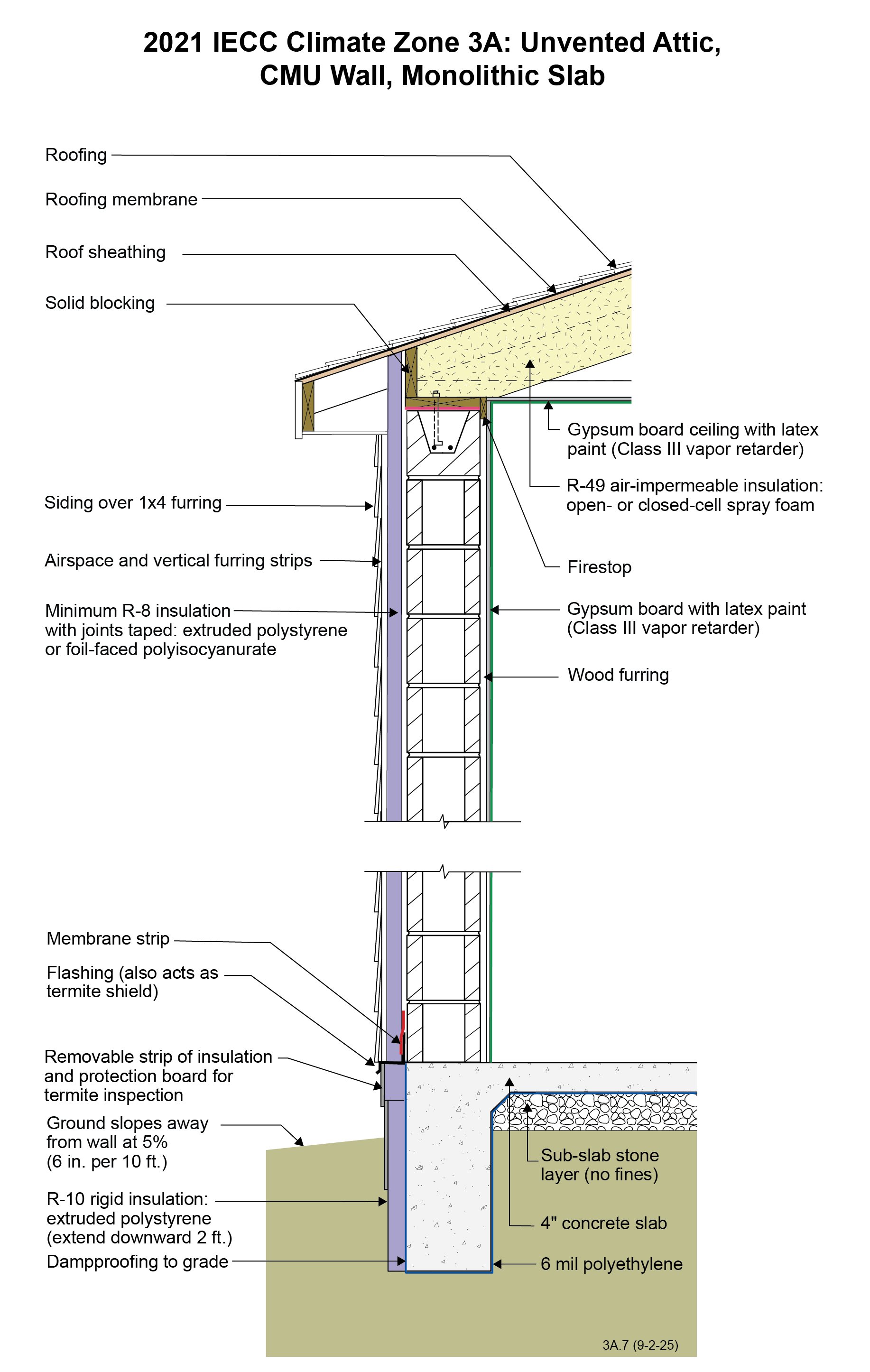
2021 IECC Climate Zone 3A: Unvented Attic, CMU Wall, Monolithic Slab
Notes
IECC CZ 3A: Unvented Attic, CMU Wall, Monolithic Slab
- The attic insulation in this unvented attic is located on the underside of the roof sheathing. To prevent moisture issues at the roof deck, one or more of the following vapor-control approaches can be used:
- Use air-impermeable insulation such as spray polyurethane foam (open cell or closed cell).
- Install airtight vapor diffusion ports, allowing air-permeable insulation such as cellulose or fiberglass to be used.
- Install minimum R-5 air-impermeable insulation against the roof deck, allowing air-permeable insulation such as cellulose or fiberglass to be used to make up the rest of the total R-value requirement of R-49. The air-impermeable insulation can be spray polyurethane foam or rigid foam board (with joints sealed), installed against the underside of the roof decking or on the exterior side of the roof decking.
- Install a vapor-permeable roof underlayment and vapor-permeable roofing (such as tile), allowing air-permeable insulation such as cellulose or fiberglass to be used.
- Install dehumidification in the attic space.
- Unvented attics are more resistant to wind uplift under hurricane conditions.
- If a raised-heel roof truss is used to allow R-38 attic insulation over the full width of the exterior wall, then R-38 can be used throughout the attic rather than R-49. See Section R402.2.1 of the 2021 IECC.
- The CMU block wall is insulated on the exterior with XPS or foil-faced polyisocyanurate rigid foam. By taping the joints and seams in the foam, the exterior face of the foam can act as the water control layer. Drainage is facilitated by the gap created by vertical furring strips between the exterior face of the rigid foam and the siding.
- A Class III vapor retarder (latex paint) is used on the interior surface of the walls and ceiling instead of a vapor barrier. This allows drying to the interior. Avoid vinyl wallpaper and oil-based paint or coatings in Climate Zone 3. These wall coverings are vapor impermeable and increase the risk of condensation within the wall.
- The polyethylene vapor barrier under the concrete slab extends over the top of the CMU stem wall to act as a capillary break.
- The flashing at the base of the above-grade wall is sealed to the water control layer with a membrane strip to control insect entry.
- Portions of the CMU wall may need to be filled solid to meet structural requirements or to accommodate anchor bolts for a sill plate.


