




Drawings
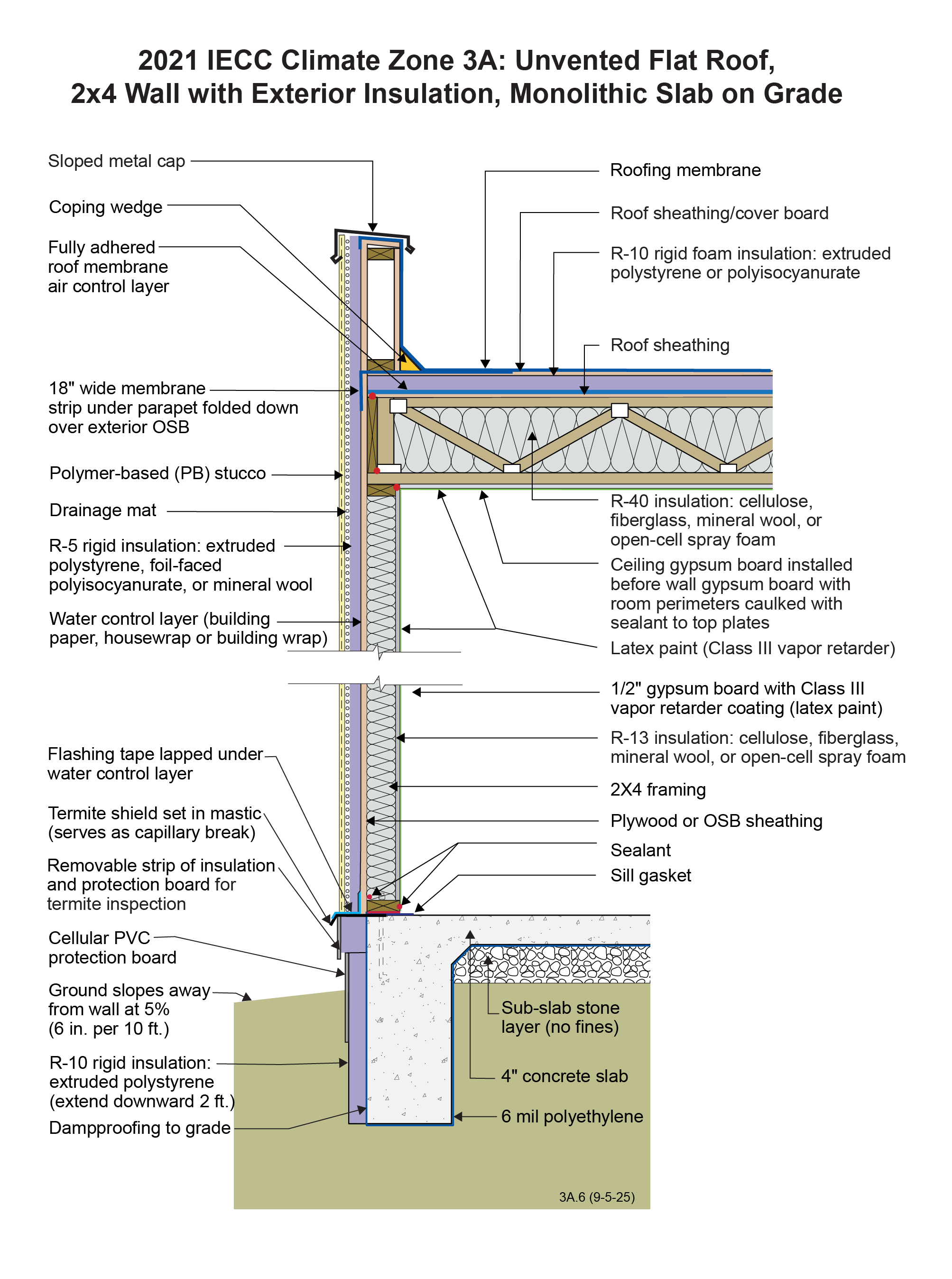
2021 IECC Climate Zone 3A: Unvented Flat Roof, 2x4 Wall with Exterior Insulation, Monolithic Slab on Grade
Notes
IECC CZ 3A: Unvented Flat Roof, 2x4 Wall with Exterior Insulation, Monolithic Slab on Grade
- The rigid foam insulation at the exterior of the roof deck is required to control condensation because there is no interior vapor barrier; there is a vapor “retarder” (semi-permeable latex paint on the ceiling acts as a Class III vapor retarder). The reason that there is no interior vapor barrier is to permit drying to the interior.
- The required rigid foam R-value depends on the R-value of the cavity insulation. In Climate Zone 3A, per Table 806.5 of the 2021 IRC, the R-value of the rigid foam should be at least R-5. DOE-funded research has shown that the R-value of the rigid foam should be at least 10% of the total R-value in Climate Zones 1, 2, and 3. In any case, the total of the cavity insulation plus the rigid foam insulation must be at least R-49 to meet energy efficiency code (2021 IECC). R-5 rigid insulation over R-45 cavity insulation would meet these requirements (5 / (45+5) = 10%). The drawing is conservative and shows R-10 rigid foam over R-40 cavity insulation. This exceeds the vapor control requirement and meets the efficiency code requirement of R-49.
- A drainage mat is provided behind the stucco layer to provide water drainage. This assembly is drained to the exterior via the flashing installed over the termite shield. The vertical section of flashing must be overlapped by the wall’s water control layer.
- A class III vapor retarder (latex paint) is used on the interior surface of the walls and ceiling instead of a vapor barrier. This allows drying to the interior. Avoid vinyl wallpaper and oil-based paint or coatings in Climate Zone 3. These wall coverings are vapor impermeable and increase the risk of condensation within the wall.
- The entire monolithic concrete slab should have a polyethylene vapor barrier wrapping the underside of the slab and footing to control capillary uptake. The polyethylene should extend upward from the bottom of the footing to grade on the exterior.
- A termite inspection strip should be included at the top of the slab edge insulation. Note that slab edge insulation is not required if the home is in an area deemed to have very heavy termite infestation. See 2021 IRC 402.2.9.


