
Description

DOE Zero Energy Ready Home (Revision 07)

Exhibit 2 DOE Zero Energy Ready Home Target Home.
The U.S. Department of Energy’s Zero Energy Ready Home program allows builders to choose a prescriptive or performance path. The DOE Zero Energy Ready Home prescriptive path requires builders to meet or exceed the minimum HVAC efficiencies listed in Exhibit 2 of the National Program Requirements (Rev 07), as shown below. The DOE Zero Energy Ready Home performance path allows builders to select a custom combination of measures for each home that is equivalent in performance to the minimum HERS index of a modeled target home that meets the requirements of Exhibit 2 as well as the mandatory requirements of Zero Energy Ready Home Exhibit 1.

Exhibit 2, Insulation and Infiltration) Whole house leakage must be tested and meet the following infiltration limits:

  • Zones 1-2: ≤ 3 ACH50;
  • Zones 3-4: ≤ 2.5 ACH50;
  • Zones 5-7: ≤ 2 ACH50;
  • Zone 8: ≤ 1.5 ACH50;
  • Attached dwellings: ≤ 3 ACH50.

Footnote 23) Envelope leakage shall be determined by an approved verifier using a RESNET-approved testing protocol.

How to Determine Infiltration

Building envelope leakage should be determined by an approved verifier using a testing protocol approved by the Residential Energy Services Network (RESNET). Whole-house air leakage testing is conducted with a blower door test.

Climate zones are based on the Climate Zone Map, which can be found in the 2015 International Energy Conservation Code (2015 IECC Figure R301.1):
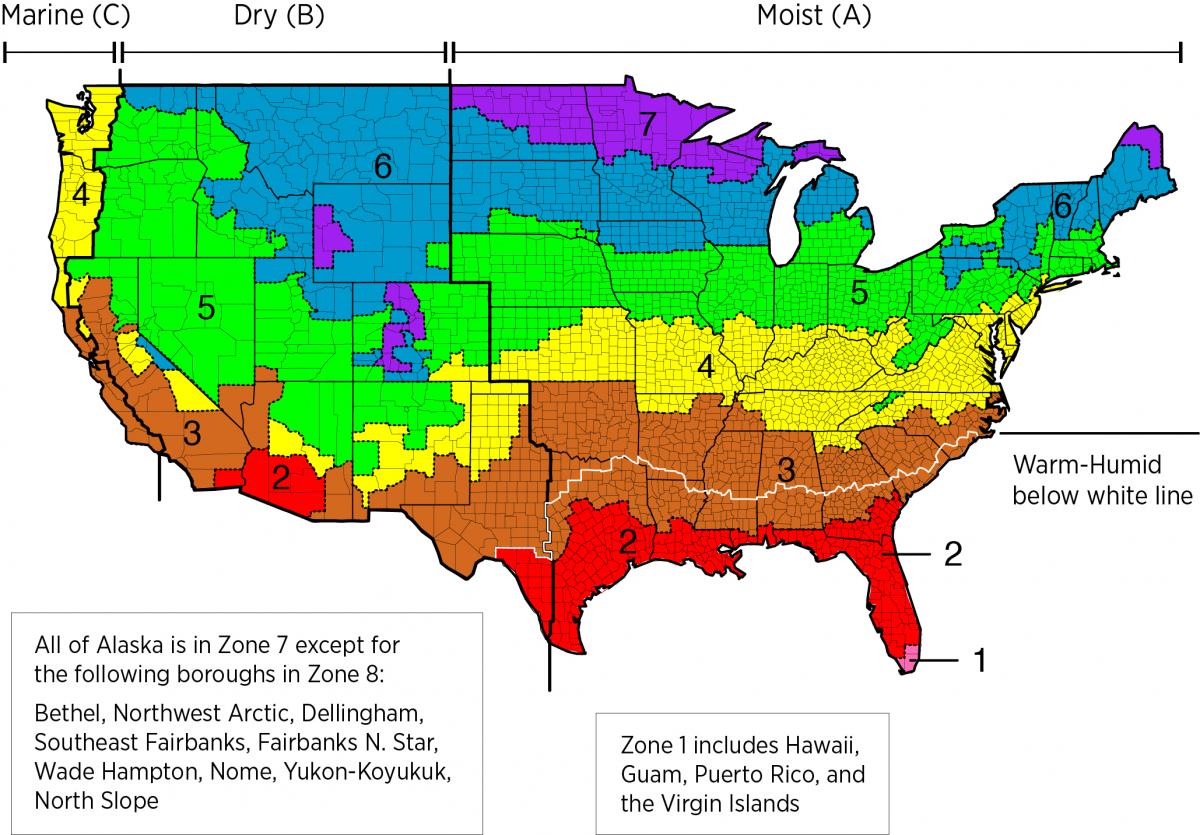
IECC climate zone map.
Figure 1. IECC climate zone map.


More Info

References and Resources*

Publication Date
·
Author(s)
U.S. Department of Energy
·
Organization(s)
DOE
Description
Website listing implementation timelines and links to various versions of the DOE Zero Energy Ready Home national program requirements.

* For non-dated media, such as websites, the date listed is the date accessed.

Last Updated

Disclaimer

This content is a work created with funding provided by the United States Department of Energy under Contract no DE-AC05-076RL01830 for the operation of Pacific Northwest National Laboratory. The information and guidance provided by Pacific Northwest National Laboratory (PNNL) in the content are intended solely for educational purposes only and do not constitute formal training or certification. It is provided with the explicit understanding that neither the United States Government nor the United States Department of Energy, nor the Contractor, nor any or their employees, nor any jurisdiction or organization that has cooperated in the development of these materials, makes any warranty, express or implied, or assumes any legal liability or responsibility for the accuracy, completeness, or usefulness or any information, apparatus, product, software, or process disclosed, or represents that its use would not infringe privately owned rights. Reference herein to any specific commercial product, process, or service by trade name, trademark, manufacturer, or otherwise does not constitute or imply its endorsement, recommendation, or favoring by the United States Government or any agency thereof, or Battelle Memorial Institute. The views and opinions of authors expressed herein do not necessarily state or reflect those of the United States Government or any agency thereof. Viewers assumes full responsibility for all actions that they may take from information provided in this content including ensuring the safety, code compliance, and proper functionality of any products they choose to install. Installation and use of such products should be performed in accordance with local regulations and manufacturer instructions.