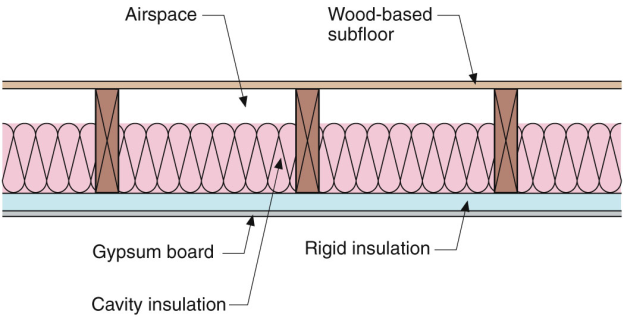
Previous codes (prior to the 2015 IECC/IRC) only addressed one option for insulating floors, requiring insulation in floors to be in direct contact with the underside of subfloor decking. However, another option that is now defined in the 2015 IECC/IRC, is to have an airspace between the floor sheathing and the top of the cavity insulation where the cavity insulation is in direct contact with the topside of sheathing or continuous insulation installed on the underside of the floor framing and is combined with perimeter insulation that meets or exceeds the R-value requirements for walls. This second option leads to fewer cold spots yet does not change the heat loss as long as the cavity insulation is in direct contact with sheathing below it or continuous insulation below it. It also facilitates services to be enclosed within the thermal envelope.
If an older version of the code is being enforced in your location, the approach to overcome this barrier is to reference this version of the code as documentation for acceptance for compliance.
Plan Review
- Ensure the drawings and construction specifications detail the layering of insulating materials – the individual and total R-values of insulating materials comprising the building envelope assembly.
- Confirm insulation placement and an air barrier is specified at exposed edges of insulation on drawings.
- Refer to code citations on insulation and air barrier placement: reference 2015 IECC/IRC, Section R402.2.8/N1102.2.8, Table 402.4.1.1 (N1102.4.1.1). An excerpt from the Table R402.4.1.1 is below.
| Component | Insulation Installation | Air Barrier |
|---|---|---|
| Floors (including above garage and cantilevered floors) | Floor framing cavity insulation installed to maintain permanent contact with the underside of subfloor decking, or floor framing cavity insulation permitted to be in contact with the top side of sheathing, or continuous insulation installed on the underside of floor framing and extends from the bottom to the top of all perimeter floor framing members. | Air barrier installed at any exposed edge of insulation |
Field Inspection
Depending on proposed insulation installation verify proper installation of the following:
- Floor framing cavity insulation – installed to maintain permanent contact with underside of subfloor decking
- Sheathing or continuous insulation installed – confirm floor framing cavity insulation is in contact with the top side of sheathing or continuous insulation installed on the underside of the floor framing and extends from the bottom to the top of all perimeter floor framing members
- Confirm an air barrier is installed at all exposed edges of insulation
Technical Validation(s)
Building Science Corporation
http://www.buildingscience.com/documents/insights/bsi-064-bobby-darin-thermal-performance?topic=doctypes/insights