An official website of the United States government
Here's how you know
Official websites use .gov
A .gov website belongs to an official government organization in the United States.
Secure .gov websites use HTTPS
A lock (
) or https:// means you’ve safely connected to the .gov website. Share sensitive information only on official, secure websites.
Fact sheet from Wisconsin Focus on Energy explaining how to prevent future ice dams on homes by learning about their formation and mitigation of contributing factors.
Video interview explaining some basic guidelines to make your home more ready for severe weather for under $10,000. Recommendations from FLASH Strong Homes.
A starting point for ballparking and comparing the cost of different siding materials and a brief overview of the pros and cons of different siding materials.
An example of a form a building codes department created to ensure builders are fully aware and have taken steps to provide drainage so that water doesn’t accumulate behind siding. This example is from the city of Newberg, Oregon.
Article describing how omission of two small but critical wall details, a kick-out flashing and a weep screed, lead to extensive water damage to a wall.
Document focusing on the design and wall components that contribute to a pressure equalized rain screen wall, including the frequency of the weep holes and other brick masonry rain screen wall requirements.
Video showing how the weep holes in a brick façade are sometimes filled by the homeowner or subsequent contractor who mistakenly thought the holes are the result of an installation error during the brick laying work. These holes are important to the drainage and ventilation of the wall, please don’t...
A presentation about the need for rainscreens including the damage water and moisture ingress into a home’s siding and framing can cause, and ways to design a resilient wall that drains and ventilates well.
Fact sheet describing how typical wall moisture barrier systems work, the moisture barrier system and common problems associated with them; also published in FEMA P-499 “Home Builder’s Guide to Coastal Construction: Technical Fact Sheet Series.”
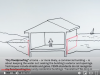
Video describing how wet floodproofing helps prevent flood damage by using four different design strategies; elevate, float, wet floodproof, and dry floodproof. Recommendations from the National Building Museum.
Video showing how to protect your home via Huber ZIP System Roof Sealing and Tape from moisture problems arising from high wind or hurricane damage per FLASH Strong Homes guidelines.
Article about how mortar droppings during the installation of a brick veneer can clog the weep holes in the wall assembly causing moisture damage. The article also illustrates products that can be installed in the ventilated cavity to mitigate this problem.
Vapor retarder plastic should not be installed over fibrous insulation on basement or crawlspace walls; rigid foam or spray foam should be installed directly against the concrete, behind the blanket insulation.
Standard describing a simple, relatively cost-effective approach to evaluating the ability of a variety of materials to support microbial growth using a small chamber method. A preview of the standard is available at the link, with the full version available for purchase.
Specification describing criteria for manufactured polymeric materials used to provide a rainscreen function, a means for the drainage of liquid moisture and the ventilation of vapor moisture that enters an above-grade exterior wall assembly which was published in the year 2019, and is available for...
Report that demonstrates the durability, constructability, and cost-effectiveness of the extended plate and beam (EP&B) wall system for new construction housing projects in compliance with the International Energy Conservation Code, addressing moisture risk management and high-performance envelope...
Webinar from a group of indoor air quality experts on compliance with EPA's Indoor airPLUS program as multifamily buildings reach past five stories high, with special consideration taken for ventilation, air sealing, moisture control, and indoor air quality needs in larger residences.
Webinar from Nick Hurst, Gayathri Vijayakumar, and Karla Butterfield for EEBA on compliance with EPA's Indoor airPLUS program as multifamily buildings reach past five stories high, with special consideration taken for ventilation, air sealing, moisture control, and indoor air quality needs in larger...
Video showing steps to take to prepare openings in homes for a hurricane or high wind event as explained by the Weather Channel and IBHS Fortified Home.