



Scope
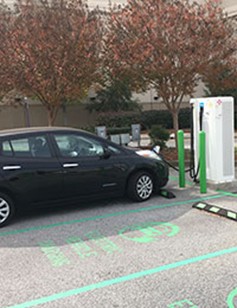
Install electric vehicle (EV) chargers at a multifamily property:
- Choose EV chargers that align with the needs of your residents (in miles of range per hour charged).
- Prior to installation, have a professional conduct an electrical assessment to ensure that your property has sufficient electrical capacity for EV charging.
- Engage with your local permitting authority before the charger is installed to ensure you are complying with all code requirements for your area.
Have a licensed professional install the EV chargers on your property.
See the Compliance tab for links to related codes and standards and voluntary federal energy-efficiency program requirements.
Description
Electric vehicle chargers (EV chargers) deliver electricity from the electrical grid or onsite energy sources to the battery of an electric vehicle (EV). EV chargers are also referred to as “electric vehicle supply equipment” (EVSE) in the industry.
The majority of EV chargers installed in the United States provide alternating current (AC) charging at 120 – 240 volts (V). EV chargers utilizing a 120V circuit are sometimes referred to as “Level 1” (L1) charging, while chargers on a 240V circuit are commonly referred to as “Level 2” (L2) charging. Some EV chargers provide direct current (DC) charging to the vehicle, often at 480V or higher, enabling a faster rate of charging – these “DC fast chargers” (DCFC), sometimes referred to as “Level 3” (L3) chargers, are often installed to enable long-distance travel or to provide charging for those without access to home charging. This guide primarily focuses on L1 and L2 chargers, as those are most commonly installed at multifamily properties, though in some rare cases L3 may be appropriate.
L1 charging uses 120V electrical supply, the same as a common household electrical outlet, and L1 chargers are typically portable and plug into a wall outlet. For most residential applications, L1 charging is sufficient for daily driving, and will provide up to 40-50 miles of driving range over 8-10 hours of charging. Those who drive more may require L2 charging.
L2 charging uses 240V electrical supply, similar to most electric clothes dryers. L2 chargers can be hardwired into the building electrical supply or plugged into a 240V outlet. L2 charging can provide 200 miles or more of range in an 8-10 hour overnight charge.
Low Power Level 2 (LPL2) charging provides a medium between L1 and L2, utilizing 240V electricity, but at lower amperage. LPL2 chargers, like L1, are typically portable, and plug into a 240V outlet, but use a less common wall plug type. This solution may be preferable for drivers that want a faster charging solution than L1, but have limited panel capacity that will not support an L2 charging circuit.
L3 has the fastest charging capabilities but are not common in most multifamily settings due to their cost, space, and power requirements. L3 may be installed in multifamily properties to provide a luxury amenity.
Table 1 summarizes these levels of charging stations and their capability. Average costs are dependent on multiple factors, which is covered in the “General Steps and Considerations for Installation” section.
Type of EV Charging (Voltage Required) | Voltage Required | Estimated* Charging Rate | Use Case |
|---|---|---|---|
AC Level 1 Charging (L1)
| 120V circuit | 2-5 miles | 7+ hours of overnight/all day parking Best for residential, work, and school applications |
AC Low-Power Level 2 Charging (LPL2)
| 208/240V circuit | 8-12 miles | 4-7+ hours overnight/all day Parking Best for residential settings |
AC Level 2 Charging (L2)
| 208/240V circuit | 20-30 miles | 2-7+ hours of parking Best for residential, work, schools, hotels, retail, public access, travel corridors, and fleet center applications |
DC Level 3 Charging (L3 or DCFC)
| 480V, 3-phase power required | 100-200+ miles | <1 hour quick charging Best for on route charging or regular quick daily charging for drivers without access to L1 or L2 chargers |
| *charging rates are rough estimates and can vary depending on the vehicle efficiency and vehicle’s current state of charge | |||
Charging rates are rough estimates and can vary depending on the vehicle efficiency and vehicle’s current state of charge (SoC), particularly for DC fast charging. Charging occurs fastest at low SoC levels and slows as the battery approaches full capacity to prevent battery damage and optimize battery life longevity. Improvements in battery technology and vehicle architecture may improve these values in the future.
Plug-In EV Chargers and Outlets vs Hardwired EV Chargers
EV charging can be provided with either a dedicated EV outlet or a hardwired EV charger. Outlets (also known as receptacles) allow the EV driver to plug in an L1, LPL2, or L2 plug-in EV charging cord, which is typically provided with the purchase of a new EV. Hardwired EV chargers are typical for L2 or L3 charging stations, which can be wall-mounted or pedestal-mounted (Figure 1).
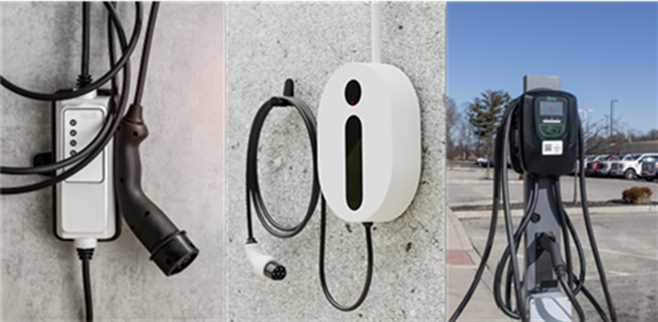
Source
Plug-in EV chargers that utilize outlets provide a low-cost solution for charging an EV. A portable charging cord is typically provided with the EV or can be purchased for $200-$300 (as of 2025), depending on the functionality and level of energy it can transfer to the vehicle. Some multifamily properties may also want to consider providing a locking cover to prevent theft of the cord while charging.
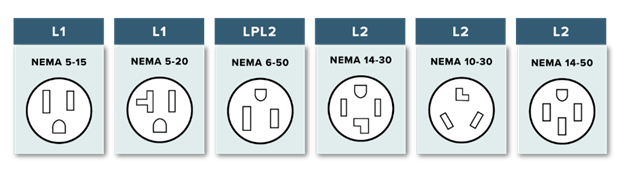
L1 chargers plug into a NEMA 5-15 or 5-20 receptacle, depending on the type of plug on the EV charger. LPL2 chargers utilize a NEMA 6-50 outlet receptacle, and L2 chargers can utilize a variety of 30- or 50-amp NEMA receptacle types. Some portable EV chargers have adapters to allow compatibility with multiple outlet types.
Users should take care to ensure portable EV chargers and any adapters carry safety certification from a reputable nationally recognized testing laboratory. Products listed on the ENERGY STAR Product Finder and the EPRI Product List will meet industry safety standards.
Figure 2 shows the typical outlet types used for plug-in EV chargers.
Source
L2 and L3 charging stations are typically hardwired, with the EV charger wall-mounted or pedestal-mounted depending on the site configuration. With the added cost of the EV charger and higher power, L2 charging (both plug-in and hardwired) is typically more expensive than a lower-powered L1 or LPL2 charger, but can provide faster charging in addition to more functionality.
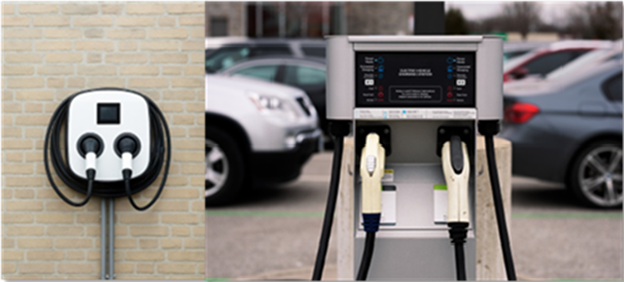
Some L2 EV chargers also come in the form of dual-port chargers (a single charging station that has two connectors), which allow two EVs to be charged by the same charging station (Figure 3). These may have two circuits (one for each connector) or share a single circuit, splitting the power when multiple vehicles are charging. These options can be ideal in multifamily properties to conserve space and to also work within the available electrical capacity by sharing the same circuit.
Source
Multifamily properties may also want to consider cable management systems (Figure 4) to keep the charging cord off the parking surface, as some EV charger designs intend the cable to be wound around the charging unit. There is an additional cost for cable management, otherwise the cord must be manually restored after each use to prevent a tripping hazard. Some systems supply a retractor that is added to the top of the pedestal or attached to a wall to automatically retract and store the cable.

Source
EV Charging Ports
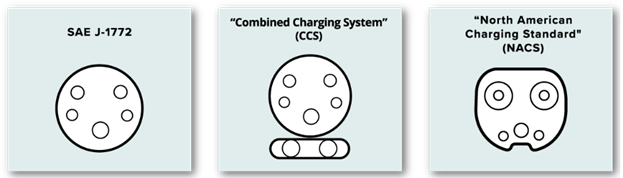
Different vehicle makes and models may utilize different port styles to connect the EV charger to the vehicle. Historically, most automakers in the United States used the SAE J-1772 plug type (Figure 5). This connector is used for L1, LPL2, and L2 charging.
Some vehicles utilize the SAE Combined Charging System (CCS) connector, which can connect to L1, L2, or L3 chargers (Figure 5).
One major manufacturer has historically used the North American Charging Standard (NACS or J-3400) plug type, which can charge at L1, LPL2, L2, and L3 (Figure 5). Most automakers have made announcements that they plan to switch their vehicle designs to utilize the NACS connector beginning in model years 2025-2026. Since many older vehicles will remain on the road for years to come, drivers will likely rely on adapters for cross-compatibility while the vehicle stock slowly transitions from J-1772 and CCS to NACS.
Source
Networked vs Non-Networked Chargers
EV chargers are often categorized as networked or non-networked. Non-networked chargers have no capability to communicate or manage their use; they simply plug in and start charging once connected to a vehicle. Given their simplicity, they are typically lower cost.
Networked chargers, also known as “smart chargers,” have greater functionality due to their ability to communicate with other chargers, devices, and cloud management systems via a network. In a multifamily property, where managing multiple EV chargers is necessary, networked chargers may be very useful.
These chargers typically use a cell modem, Wi-Fi, Bluetooth, or hardwired networking for communications. Smart chargers can come with capabilities such as user access permissions, payment processing, data tracking, and load management. These technologies can improve the user experience as well as the property manager’s ability to minimize electricity costs, collect revenue, and manage charging access. Smart chargers can come in all levels of charging but are typically L2 and L3 chargers. There are also smart outlets becoming available in the market that provide simple levels of smart functionality such as power sharing, data collection, or payment options. Smart chargers and smart outlets typically need to be installed by an electrician.
Smart chargers can also help to enable load management to take advantage of time-of-use (TOU) or EV rates or demand response programs, shifting EV charging loads to lower-cost hours of the day.
Networked chargers typically come at a premium cost, with higher equipment costs, and some require ongoing networking and service plan fees. Due to their more complex nature, networked chargers have more opportunity for maintenance issues. While some maintain basic charging functionalities when the network is down, some providers rely on the network to function properly. Smart outlets can be lower cost than a smart charger, but, like smart chargers, can have ongoing fees to cover networking costs.
Below is a list of the key capabilities of networked chargers:
- Remote monitoring of status, which can be used to quickly identify chargers needing maintenance.
- Regular (typically monthly) usage reporting detailing which EV charger is being used, when, and for how long.
- Determining which EV drivers have access to the charger (public, semi-private, or private).
- Setting EV charging session billing rates for drivers.
- EV charging session payment collection through RFID fob, credit card, or smartphone app.
- Automated load management and power sharing capabilities.
EV Chargers in Building Codes and Standards
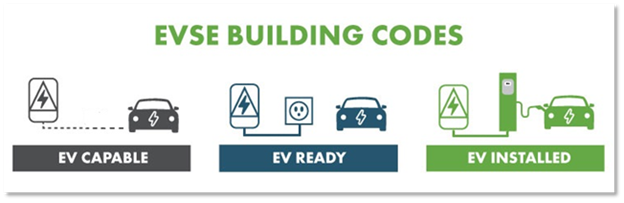
There are 3 main categories of electric vehicle infrastructure (EVI) that are referenced in building codes. These categories include EV-Capable, EV-Ready, and EV-Installed (Figure 6).
Source
An EV-Capable space is a parking space that is prepared for an L2 charger (but can also serve L1 or LPL2) and includes the following components:
- Electrical Panel Capacity: The electrical panel has enough physical space and capacity to handle the additional load of a minimum 40-ampere, 208/240-volt branch circuit for future EV charging.
- Dedicated Breaker: There's a specific breaker slot dedicated to powering the EV charging station, preventing other loads from taking its space. A breaker is not required to be installed.
- Raceways (Conduits): Conduits are installed to allow for the easy and safe installation of future wiring for the EV charging station.
- Transformers: Due to the cost and difficulty in upsizing electrical transformers in an existing building, transformers should be sized according to anticipated future EV loads.
- No Charging Equipment Installed: EV-Capable spaces do not have the circuitry or EV charging equipment (EVSE) installed, such as a hardwired Level 2 charger, but should have a termination like a junction box in close proximity to the intended parking space for easy future installation.
An EV-Ready space builds upon the requirements of an EV-Capable space by ensuring there is a dedicated branch circuit (wiring) installed that terminates in a junction box, outlet (or receptable) near the EV parking space. By installing a receptacle at an EV-Ready space, a driver can easily plug in their own connector cord and begin charging.
EV-Installed is when all the elements of an EV-Ready space are installed, plus an EV charger. The parking space can charge an EV without the need for any additional installation or equipment.
General Steps and Considerations for Installation
Planning and Preparation
Planning and preparing for installing EV infrastructure is crucial to ensuring a successful project. Installing EV infrastructure at a multifamily property requires many steps and decisions with multiple stakeholders. The following sections outline the most important steps of this process. For additional information on things to consider when installing EV charging station(s) at a multifamily property, see Plug-In Electric Vehicle Handbook for Public Charging Station Hosts.
Electrical Assessment
One of the first important steps is understanding your available electrical capacity at the site. This will allow you to understand the potential limitations of what charging level and quantity of chargers you can install.
For multifamily properties, a comprehensive electrical assessment should be conducted to understand the capacity available to install EV chargers. This assessment will provide insight into the quantity and level of chargers that can be installed within existing capacity, or if additional capacity is needed. Multifamily properties may consider lower power EV chargers (such as L1 chargers) or power sharing strategies under electrically constrained scenarios (see this guide's “Strategies to Work Within Available Electrical Capacity” section). These low-power solutions can meet the charging needs of most tenants, without adding significant cost to the property owner.
Upgrading electric panels and other infrastructure for greater capacity can add significant project costs, which are highly dependent on site-specific factors. A panel upgrade may trigger an upgrade to the utility electrical service, which can take several months and potentially add tens of thousands of dollars depending on your utility provider and site-specific details.
Identifying Locations
Finding the best location for EV chargers is important as it will impact both costs and accessibility for the user. Generally, locations that are closer to the electric panel will reduce infrastructure and installation costs, as many materials and installations costs, including conduit, circuit runs, and trenching, increase per foot of distance from the power source. However, multifamily property owners should also balance these costs with the users’ experience and spacing requirements for ADA compliance. More information on ADA compliance can be found in this guide's “Accessibility and Other Considerations” section.
To ensure resident satisfaction and high utilization, placing EV chargers in convenient locations is important. For example, chargers should not be placed far away from resident units. Additionally, placing EV chargers in highly visible stalls can be helpful for curb appeal and attracting potential future residents.
Assess Type and Quantity of Chargers
While your electrical assessment, ideal location(s), code requirements, and budget will be the main factors in determining the type and quantity of chargers you choose to install, it’s important to understand that there are a variety of chargers to choose from to meet your needs. To understand your charging needs, it’s helpful to understand first how far users will typically drive. For example, is your property in a rural area far from businesses and offices, or is it located downtown close to most businesses and offices? This will help you understand what level of charging you need for how long a vehicle is parked at a station, commonly referred to as the “dwell time.”
In planning for the type and quantity of chargers, it is also important to understand the motivation for installing EV chargers:
- Is it to meet relevant code requirements?
- Is it providing an enhanced amenity for residents?
- Is it an opportunity to generate revenue?
To ensure you are thinking about your property’s EV charging needs appropriately, see Good Questions to Ask EV Charging Equipment Vendors.
Electrical Code and Workmanship Requirements
Installation of EV charging stations at multifamily properties must be completed by a licensed electrical contractor. The Department of Energy’s Alternative Fuels Data Center can provide information on where to find electrical contractors that are qualified to install EV chargers. An electrical contractor should be aware of the relevant codes and standards and obtain a permit from the local building authorities before installing charging infrastructure, if required.
The National Electrical Code (NEC) is widely adopted by certain states and local jurisdictions. The NEC covers the majority of the electric vehicle power transfer systems requirements including the following key points:
- Branch Circuits: All EV charging equipment must be installed on a dedicated branch circuit, separate from other loads, to prevent interference and potential overloading.
- Rating: The equipment must be rated for the voltage and current levels expected during normal operation. For residential installations, this typically ranges from 120V to 240V, while commercial or fast-charging installations may operate at 480V or higher.
- Wiring Methods: NEC requires the use of listed wiring methods and materials, such as those approved for wet locations when the conduit is installed underground or outdoors.
- Ground-Fault Protection: Ground-fault protection is required for EV charging systems to minimize the risk of shock. It is particularly important in outdoor or wet environments.
- Determining Proper Electrical Load: EV charging is a continuous load. The NEC requires wiring size and overcurrent protection for EV chargers to be 125 percent of the charger’s nameplate continuous output rating. Load calculations or a load study may be required to ensure there is sufficient electrical capacity to support EV charging. Load control strategies may be employed to fit charging within existing capacity.
The National Electrical Contractors Association (NECA) Standard 413 is the standard for the installation and maintenance of EV chargers. It provides guidelines for Level 1, Level 2, and Level 3 chargers, covering safe installation, system capacity, and compliance with the NEC.
Equipment
Equipment should be certified by a nationally recognized testing laboratory and listed for electric vehicle use. The American National Standards Institute (ANSI) and Underwriters Laboratories (UL) have defined four main product safety standards for EV chargers: ANSI/UL 2202 (for L3), ANSI/UL 2594 (for Level 2), UL2252 (for adapter safety), and UL 9741 (for bidirectional charging).
Products listed on the ENERGY STAR Product Finder and the EPRI Product List will meet industry safety standards.
To learn more about relevant codes and standards for EV charging equipment, see the Compliance tab.
Engaging the Utility and Local Jurisdiction Early
For projects that will need to upgrade electrical service to meet the needs for EV charger installation, it’s important to engage your utility early to ensure you can plan according to their availability to upgrade your service.
Utilities can provide in-depth analysis of power availability and capacity for infrastructure planning. Some utilities also offer programs specific to EV charging to mitigate grid impacts, such as demand response programs. This allows a utility to remotely control EV charging by increasing, decreasing, or turning off charging to help meet the needs of the grid. In addition, utilities can offer incentives or unique ownership models for charging equipment and installation. Use the U-Finder tool to identify your utility partners, get their contact information, and learn about their EV charger installation efforts.
Engaging your local jurisdiction early will help you understand the local code requirements and permitting process which could require a site installation plan, and approval from fire, environmental, or electrical inspection entities. During the planning and procurement process, property owners may also choose to engage their local Clean Cities and Communities Coalition and state and local governments for advice and guidance.
Accessibility and Other Considerations
Multifamily EV charger installations have additional parking considerations such as the Americans with Disabilities Act (ADA) requirements. Some EV charging incentive programs, state governments, or local governments may require that new EV charging installations are ADA-compliant. Key considerations include ensuring adequate space for exiting and entering the vehicle, unobstructed access to the charging station, free movement around the charging station and connection point on the vehicle, clear paths and proximity to building entrances, and appropriate signage.
Signage and pavement markings may be necessary to help inform drivers (Figure 7). State and local governments may have requirements concerning EV charging infrastructure signage and marking requirements. Other considerations for installing EV charging infrastructure include lighting, and safety, and vandalism prevention strategies (e.g., motion detectors, anti-vandalism hardware). For more information on accessibility considerations, see the United States Access Board’s Design Recommendations for Accessible Electric Vehicle Charging Stations.
Source
Website describing electric vehicles, electric vehicle charging stations, and incentives for installing electric vehicle charging stations.
Strategies to Future-Proof Properties
The costs associated with installing EV charging infrastructure during new construction are substantially lower compared to a retrofit. Installing infrastructure during new construction avoids the retrofit costs of breaking and repairing existing materials (e.g., walls, slabs, sidewalks, etc.), installing longer raceways, and upgrading service panels.
When planning, it’s important to consider future plans for the site. Do you plan to install more EV chargers, electrical appliances, solar panels, or battery storage? Are there energy efficiency upgrades you can make to lower the property’s current electrical demands? Anticipating future projects can help you reduce costs by doing what you can at the time of installation. By understanding your future needs, you can plan your electrical capacity accordingly, ensure electric panel space for breakers, and run conduit and even circuits to ensure simple and cost-effective installations of EV chargers or other electrical appliances in the future. In a multifamily setting, upgrading electrical service and transformers can be very costly and add months in timeline delays.
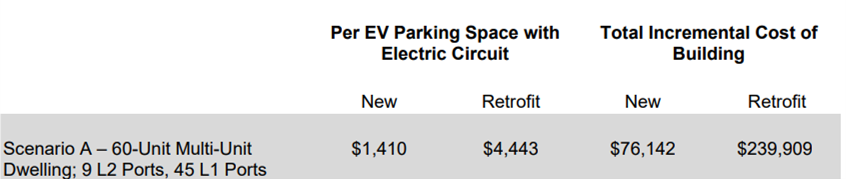
Table 2 shows the results of an analysis that compares the incremental cost of installing the necessary electrical infrastructure to support L1 and L2 EV-Ready spaces (i.e., including a complete circuit) at the time of new construction versus a retrofit project. The analysis considers a 60-unit multifamily building. These additional retrofit costs typically include labor expenses for demolition, trenching and boring, balancing the circuits, and new permitting costs.
Source
Report describing market trends for electric vehicles and summarizing energy codes and standards in the United States related to electric vehicles.
Strategies to Work Within Available Electrical Capacity
As mentioned, EV charging with a new or existing building will ultimately be limited by the size of the site’s electrical service and electrical transformer.
For installations where a single EV charger or outlet is installed on a residential panel, there are a few strategies to consider to stay within your available capacity. The below options are listed roughly in order of affordability.
- Low Power Chargers: L1 or LPL2 chargers require 25-50% less power than an L2 charger, which can help installations stay within capacity.
- Meter Collars, Circuit Splitters, Smart Breakers, or Energy Management Hardware Device: These devices monitor the overall power available on the panel or an individual circuit and temporarily pause or decrease the power to the EV charging circuit when the power draw could exceed the maximum rating.
- Smart EV Chargers (aka ALMS): Smart chargers can monitor the total electrical load across multiple chargers and limit their power draw to stay within the allotted amperage of the circuit or panel they share, also referred to as automated load management systems (ALMS).
- Smart Panel: If replacing or upgrading an existing electrical panel, installing a smart panel can allow the system to intelligently monitor and manage every energy load on the panel and adjust energy delivered based on user settings.
For multiple chargers served by the site, power sharing through an automated load management system (ALMS) allows a facility to serve more chargers using the same amount of electrical capacity. An ALMS allows you to maximize the number of electrified parking stalls by fully utilizing the available electric capacity. Costs for an ALMS are typically included in monthly subscription fees, as well as being a part of the upfront cost of the hardware.
The NEC allows multifamily EV charging projects to oversubscribe (meaning total amperage connected exceeds the capacity of the panel) the building’s electrical capacity with extra EV charging equipment if the system incorporates ALMS controls. Power sharing through ALMS caps the total power available to a site’s EV charging equipment and distributes the available power to each without exceeding the existing electrical capacity. For multiple EV chargers or outlets, ALMS or low power charging (L1 or LPL2) can allow you to increase the number of EV parking stalls within the existing capacity. Power sharing or low-power charging strategies allows for multiple EV charging and scalability for more charging spaces in the future.
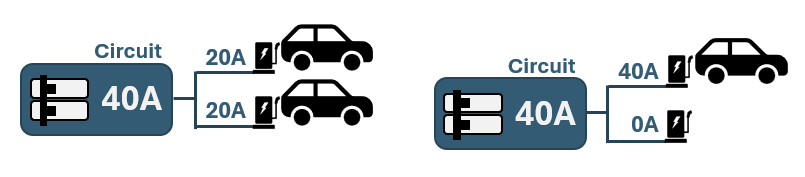
Power sharing strategies vary from relatively simple hardware settings to highly sophisticated software solutions. At its most basic, two EV chargers sharing a 40-amp circuit might both be permanently derated so the maximum amperage for each charger is 20 amps, regardless of whether both EV chargers are being used simultaneously. A performance boost comes if either charger can access the full 40 amps any time the other charger is not being used. Figures 14 through 18 illustrate this style of “static” power sharing using ALMS and a “first in, first out” strategy for allocating power. Alternatively, some systems rotate available capacity to all chargers being used for a specific period of time. “Dynamic” power sharing is a more sophisticated approach where the ALMS can vary the amount of charge going to each EV based on individual charging session needs.
Power sharing strategies illustrated in the following figures are based on Level 2 EV chargers that include a charging station and a cable ending in a connector.
Strategy #1: Energy Management Hardware Device
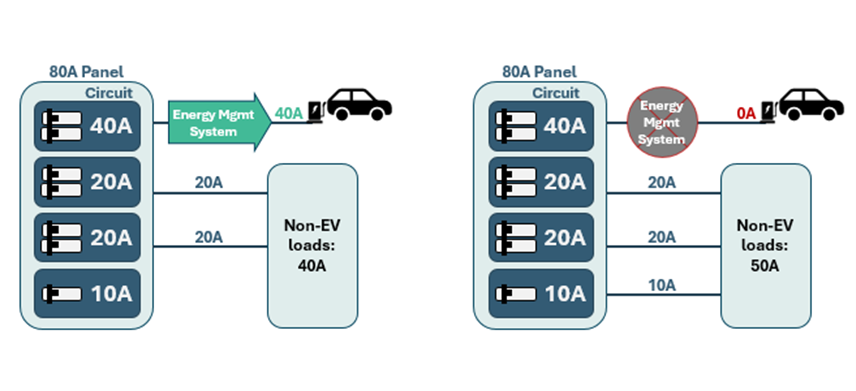
Figure 14 illustrates a simple hardware device approach to power sharing for a single Level 2 EV charger, where the EV charger circuit is split off from a panel serving a residence. With this hardware device, when the overall residential electrical panel approaches its limit, 80 amps in this case, the device turns off the circuit serving the EV charger (some devices may modulate the load to the charger rather than turning it completely off). When the non-EV loads drop back down, the device restores the connection to the EV charger. These strategies can be useful in multifamily buildings where EV chargers are wired to an individual dwelling unit’s electrical panel.
Source
Strategy #2: Circuit Sharing
Circuit sharing, the most frequently deployed ALMS, is when two or more hardwired EV chargers or outlets are wired to a single circuit and the circuit’s available current is split between them. A common installation of two EV charging ports sharing a single 40-amp circuit (a 2:1 ratio) is shown in Figure 15. When only one EV is connected to a 2:1 circuit-shared charger, the EV receives 100% of available power. When a second EV begins charging, the power is split between the two EVs. Circuit sharing is a simple and effective form of ALMS. Circuit sharing reduces installation costs since half as many circuits are needed in a 2:1 ratio compared to dedicated circuits for each charger.
Source
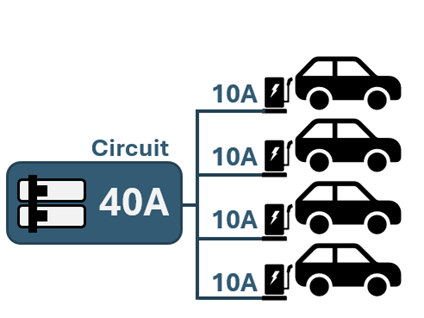
To maximize the number of electrified parking stalls, circuit sharing can go up to a 4:1 ratio, depending on the circuit amperage and minimum amperage required by the EV charging equipment (typically 8 amps). However, the more EVs charging on the same circuit, the less power each EV gets since the total output for each circuit doesn’t change. As shown in Figure 16, in a 4:1 ratio, each EV receives 25% of the 40A circuit’s available power when all four ports are being used at the same time, resulting in slower charging times.
Source
Strategy #3: Panel Sharing
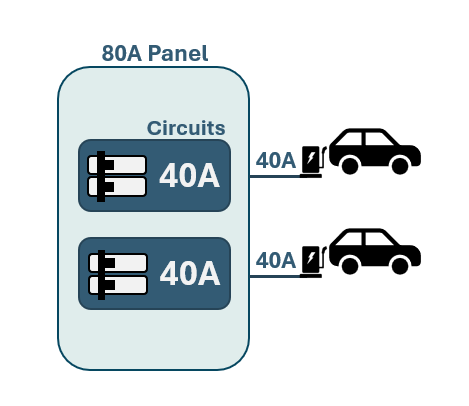
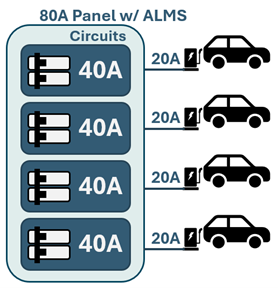
Panel sharing is another strategy to share available electrical capacity across EV chargers. However, unlike circuit sharing, in panel sharing each charging port has its own dedicated circuit which allows the ALMS to coordinate more than one circuit on the panel at a time. Sharing of available capacity at the panel is controlled by the EV charging equipment software and networked communications between the EV chargers that share a panel. In Figure 17, two EVs simultaneously charge at 40A because each EV charger has its own dedicated circuit coming from the same 80-amp panel.
Source
Figure 18 shows the same 80-amp panel that is over-subscribed with circuits totaling 160 amps. As more EVs begin simultaneously charging and the panel reaches its capacity, the ALMS limits the power to each EV to keep the total power draw within the limit of the panel. This strategy gives the ALMS increased flexibility to spread available power across more charging equipment, but has a higher upfront cost because of the additional wiring, conduit, and breakers needed for individual circuits tied to each EV charger.
Source
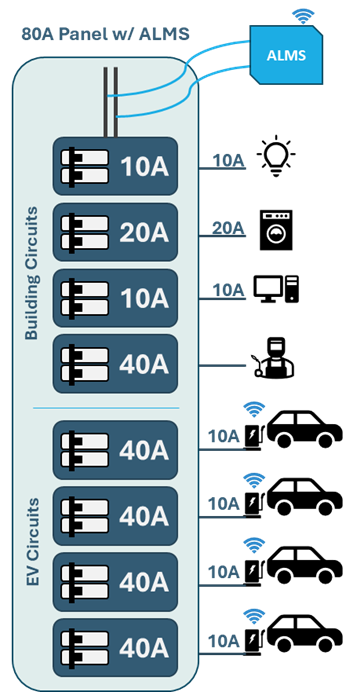
Figure 19 shows that with a more advanced ALMS, an oversubscribed panel can be managed by software to regulate more energy as needed for certain EV chargers with the available remaining capacity. In this case, the ALMS utilizes a current transformer to measure the power usage of a circuit, group of circuits, or the entire panel, and determine how much capacity is available for use by the EV circuits, allowing the ALMS to communicate with EV chargers and direct the amount of power they can safely draw while remaining within the available panel capacity.
Source
Costs
Installation costs can vary significantly based on many factors, including the number and type of chargers, geographic location, site location and required trenching, existing wiring and required electrical upgrades, labor costs, and permitting.
As of 2025, multifamily properties average around $6,000 per connector for Level 2 chargers, downstream of the electrical panel. Costs upstream of the panel can vary widely but include electrical service, trenching, meters, switchgear, electrical room, and feeders. Similarly, L3 installation costs can range from $60,000 - $150,000 or more per connector as of 2025, depending on charger power and number of installed chargers per site.
For more information on charging infrastructure cost considerations, see reports on the Costs Associated with Non-Residential Electric Vehicle Supply Equipment, Levelized Cost of Charging EVs in the United States, Reducing EV Charging Infrastructure Costs, and Breakdown of Electric Vehicle Supply Equipment Installation Costs.
Cost Considerations and Management
There are several cost and management considerations for EV chargers, including electricity costs, maintenance fees, usage fees and pricing structures, and even collecting utilization data.
For multifamily properties that plan to own or lease multiple EV chargers for their residents, maintenance and warranty considerations are key to ensure that your residents have functional charging stations.
Electricity Costs
Electricity costs associated with EV chargers will differ based on the level of equipment installed, utility rates, and the time of day, season, and length of time the charging station is used.
For multifamily properties, some utilities offer time-of-use (TOU) rates or other rate incentives for EV charging infrastructure owners, but the property manager may have less control over when residents charge, which could mean drivers charge during peak TOU periods, increasing costs to the property manager. Multifamily properties may also be subject to demand charges, in addition to energy charges, due to commercial rate structures. These charges are typically based on the maximum amount of power drawn at the meter at single point during the month. Multifamily property managers can reduce electricity costs related to EV charging by passing along TOU pricing signals to EV drivers, and by using load management to lower charging demand and reduce demand charges or shift charging to off-peak hours. See below for more information on setting fees and pricing structures for drivers.
User Pricing Structures
Common pricing structures can be by kilowatt-hour (kWh), by session, by length of time, or through a subscription. Session- and time-based structures are common in states where non-utilities are prohibited from selling electricity. While charging a fee for EVSE use is common, some public charging is free to use. There are different pricing models for property owners across charging network providers, including pricing for members versus non-members, user-specific pricing (i.e., free charging for residents and paid charging for guests), site host-specific pricing, and pricing based on charge power level.
The utilization rate of a charging station can affect the pricing structure and return on investment for installing a charging station. The New York State Energy Research and Development Authority’s report Assessing the Business Case for Hosting EV Charging Stations in New York analyzes the business case of hosting a Level 2 EV charging station and provides a business case assessment methodology for determining the break-even point for charging stations and the overall profitability of the investment.
Maintenance and Warranty Costs
General maintenance for charging infrastructure includes storing charging cables securely to prevent damage, checking parts periodically, and keeping the equipment clean. Chargers (particularly networked chargers) may also need intermittent repairs and troubleshooting. Warranty pricing varies depending on the manufacturer; plans can be fixed-term, renewable, and included with equipment costs. While routine charging infrastructure maintenance can be minimal, repairing broken chargers can be costly if they are no longer under warranty. In some cases, the easiest or cheapest option is to replace the broken charger with a new one.
For multifamily properties with several EV chargers, it is important to establish responsibility for maintenance costs and determine if the property owner, tenant, charging network, or installer is responsible. While maintenance costs vary based on the charging level and whether the charger is networked or non-networked, average maintenance costs can be up to $400 annually per charger (U.S. DOE Alternative Fuels Data Center). EV service providers may also offer a maintenance plan for an additional annual fee.
Data Collection
Capturing and analyzing charging infrastructure uptime and utilization data is a valuable component to successful charging station management for multifamily properties. Most charging networks provide utilization data to site hosts through an online portal. Property owners may capture data for non-networked charging infrastructure by installing a separate electric submeter, third-party data analytics software, or through other options offered by the charging infrastructure manufacturer. Utilization data can be used to track progress towards emissions and energy goals, determine if a certain pricing structure is successful, and evaluate the need for additional charging infrastructure. Some incentive programs may require data collection.
Incentives and Grants
To help offset costs, there are many incentives and grants available to support the installation of EV chargers depending on your location and utility provider. It is important to research the incentives available in your area when considering how much a project will cost. Incentives can be found through the Alternative Fuels Data Center and the Database of State Incentives for Renewables and Efficiency (DSIRE).
Vehicle-to-Building and Vehicle-to-Grid Capabilities
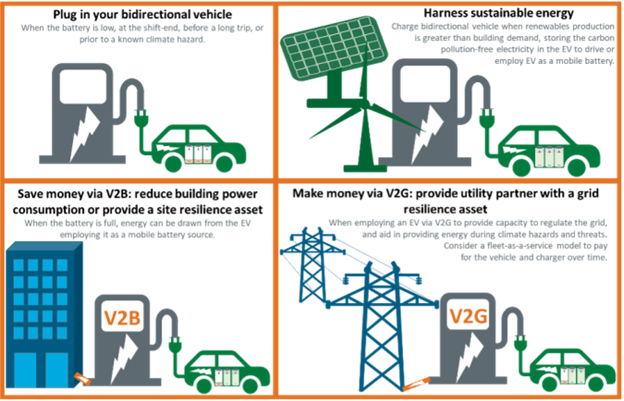
Bidirectional vehicles can provide backup power to buildings or specific loads, sometimes as part of a microgrid, through vehicle-to-building (V2B) charging, or provide power to the grid through vehicle-to-grid (V2G) charging. V2B and V2G power solutions can complement solar photovoltaic (PV) arrays and other distributed energy resources (DERs), or supplement generators as backup power (Figure 6).
Some V2B applications can add resilience to a property by:
- Acting as backup battery storage, or
- Decreasing the cost of grid electricity through TOU arbitrage (charging the vehicle during low-cost, low-demand hours and providing battery power to the home during high-cost, high-demand hours), or
- Increasing the value of local generation by storing energy produced on-site, or
- Avoiding utility-scale curtailment of renewables during clean energy periods, and feeding electricity back into the home during periods with less utility-scale renewable generation.
To take advantage of these functionalities, residents will need to have a bidirectional charging EV, and bidirectional EV chargers will need to be installed on site. Typically, bidirectional-capable charging equipment will increase costs and necessary infrastructure upgrades such as a smart inverter, panel capacity, a transfer switch, and additional software.
The V2B and V2G market is still in a nascent phase. Coordinating this functionality and getting buy-in from several residents may prove to be complicated and costly. This strategy is not currently recommended for multifamily properties at this time, but the technology is becoming increasingly available in EVs and EV chargers and is worth noting.
Source
Article describing bidirectinoal charging and energy storage methods using electric vehicles.
Ownership Models and Management
Ownership Models
There are different ownership models to consider when purchasing an EV charger. Most of these apply to networked chargers, including L2 or L3 chargers.
EV service providers (EVSPs) are third-party companies that deliver end-to-end EV charging solutions and services to owners, such as ownership and installation, management and maintenance, and payment. They may offer multiple different ownership options to property owners, while providing a range of services such as financing, ownership, management, and maintenance - often acting as a support service between the owner, EV charger vendor, and drivers. EVSPs may finance some of the upfront costs, collecting revenue back from the site host or drivers through service fees. Given the high upfront cost required for larger installations, financing arrangements can be an attractive model for property owners that want to limit their capital investment.
There are three main EV charger ownership models:
- Site-host-owned EV chargers
- Leased EV chargers
- Charging-as-a-Service (CaaS)
As shown in Table 3, service agreements can span hardware, maintenance, software, and customer support.
Ownership Models | Responsibility | |||
|---|---|---|---|---|
Hardware Ownership | Hardware Maintenance | Network Software | EV Driver Support | |
Site-Host Owned EV chargers | Property Manager | Property Manager or Vendor | Subscription* or none | Property Manager or Vendor |
Leased EV chargers | Vendor | Property Manager or Vendor | Subscription* | Property Manager or Vendor |
Charging-as-a-Service (CaaS) | Vendor | Vendor | Vendor | Vendor |
| *Subscriptions for network software may be with the EVSE vendor or a third-party network software provider | ||||
Site-Host-Owned EV Chargers
With the site-host-owned model, the property owner purchases and owns the EV chargers. This is the most common ownership model for larger multifamily properties with multiple EV chargers. If the chargers are networked, the property owner can subscribe to a network provider to access cloud-based software platform capabilities such as ALMS, access control, payment, and others mentioned in the “Networked vs Non-Networked Chargers” section.
Additionally, many vendors offer maintenance support to property owners, or even live technical support for drivers. Alternatively, the property manager can have their own personnel provide those services (with appropriate training) to reduce any ongoing fees.
Advantages of Site-Host-Owned EV Chargers:
- The property owner has full control over pricing, customer experience, and station operation.
- There is potential for revenue generation through charging fees.
- The property owner can optimize charging station usage for their specific needs.
Disadvantages of Site-Host-Owned EV Chargers:
- Requires significant upfront investment in infrastructure.
- The property owner is responsible for all operational and maintenance costs, including electricity costs.
- The property owner must have detailed knowledge of electricity rates and utility coordination.
Leased EV Chargers
In this ownership model, the property owner leases EV chargers from a vendor for a monthly fee. This fee typically includes access to the cloud-based EV charger software platform and all its capabilities. As with the owned option, maintenance and driver support may be offered by the vendor or can be provided by the property owner in exchange for a lower lease rate. By leasing, property owners can avoid or reduce fees for EV charger installation. Lease agreements have varying rate structures and terms vary.
Advantages of Leased EV Chargers:
- Reduced upfront cost.
- Vendor expertise and experience in EV charging infrastructure operation and maintenance.
Disadvantages of Leased EV Chargers:
- The property owner has less control over pricing, customer experience, and station operation.
- The property owner may need to share revenue generated from charging fees with service provider.
- The lease agreement may require multi-year contractual obligation with the service provider.
Charging-as-a-Service (CaaS)
Just as a property owner hires vendors to take care of the laundry, pool, and landscaping, there is a growing number of vendors offering a comprehensive EV charging service, or “Charging-as-a-Service" (CaaS).
In this ownership model, the property owner hires a CaaS provider who owns the EV chargers and is responsible for monitoring, maintenance, payment, and driver support. The driver still has multiple payment options, and the property owner may have discretion to set the EV charging session rates and access, depending on the structure of the contract.
Advantages of CaaS:
- There is a lower upfront investment, and the provider handles all costs associated with the charging stations.
- The provider handles all aspects of operation, maintenance, and billing, reducing the burden on the property owner.
- The property owner has access to the provider's expertise in EV charging technology and operations.
Disadvantages of CaaS:
- There are recurring fees for the use of the charging stations.
- The property owner has less control over pricing, customer experience, and station operations.
- The property owner must depend on the provider's performance and reliability.
Additional Considerations
Across ownership models, it is important to understand who is responsible for hardware ownership, maintenance, software, and customer support. Additional factors include:
- Installation Responsibilities: Vendors may not take responsibility for installing electrical capacity and circuits to the EV charger location (“make-ready” infrastructure), hence the property owner is responsible for that portion of the installation cost to make spaces EV-Ready prior to installation of the EV charger by the vendor.
- Service Level Agreements (SLAs): SLAs define key metrics including hours of customer support, length of time allowed to address maintenance needs, and uptime guarantees.
- Warranty length and inclusion: EV chargers may come with a warranty of up to five years, which may cover parts, labor, or both if the charger fails. Some vendors will sell extended warranties at an additional cost. Property owners should clearly define who is responsible for managing any repairs or replacements under the terms of the warranty.
- Revenue Potential: Depending on the ownership model, there is a potential for future revenue generation by charging for EV charger use. CaaS models may offer revenue splitting opportunities after ongoing fees are paid, depending on the structure of the contract. However, revenue generation is highly dependent on several factors such as the pricing structure, usage, charger level or type, location, and public accessibility.
Typical EV charging vendor networking fees can range from around $250 to $500 per year for networking/cloud management capabilities, up to more than $1,000 per year for more involved CaaS or leased business models. Pricing may be reduced for multi-year commitments. On top of these fees, some vendors charge user transaction fees ranging from 3% to 15% per transaction, or as a flat fee (e.g., $0.25-$0.50). Table 4 below summarizes costs and considerations associated with each ownership model.
| Upfront project costs | Operational costs | Considerations |
|---|---|---|---|
| Property Manager Owned EV Charger | $$$ | $ | Operational costs are primarily electricity usage and software licenses, repair, and maintenance. |
| Leased EV Charger | $$ | $$ | Ongoing lease and electricity usage costs. |
| Charging-as-a-Service (CaaS) | $ | $$$ | Ongoing operational costs are higher relative to the other models |
Developers are encouraged to get multiple bids from vendors and read contracts and payment structures closely, as it is common for vendors to tailor offers to projects and contract structures can differ.
Helpful Resources
Ensuring Success
Choosing and EV charger:
o The EVI-LOCATE tool can be helpful in choosing a layout and determining a cost estimate for your project.
o To understand your charging needs, it’s helpful to understand first how far the resident typically drives. This will help you understand what level of charging speed they need for the vehicle’s dwell time (how long a vehicle is parked at a station).
o When choosing a vendor for your EV charger, ask the vendor questions to make sure their products will meet your needs. San Francisco PUC has provided a list of Good Questions to Ask EV Charging Equipment Vendors.
Planning and Installation:
- Equipment should be located away from potential hazards to be protected from physical damage.
- Bollards, wheel stops or other devices can be used to ensure appropriate setbacks between vehicle and equipment.
- Equipment should be positioned to minimize tripping hazards from cords or include cord management devices, such as self-retracting reels.
Region
No climate-specific information applies.
Compliance
Retrofit
When adding EV chargers to an existing multifamily property, it is especially important to consider the site’s existing electrical capacity. It is important to hire a licensed professional to conduct a full electrical assessment prior to installing any EV chargers.
See the “Strategies to Future-Proof Properties” section of the Description tab for strategies to stay within your property’s existing electrical capacity.
More Info
Case Studies
References and Resources
*For non-dated media, such as websites, the date listed is the date accessed.
Questions? Comments? Contact our webmaster.