Image
Courtesy Of
Notes
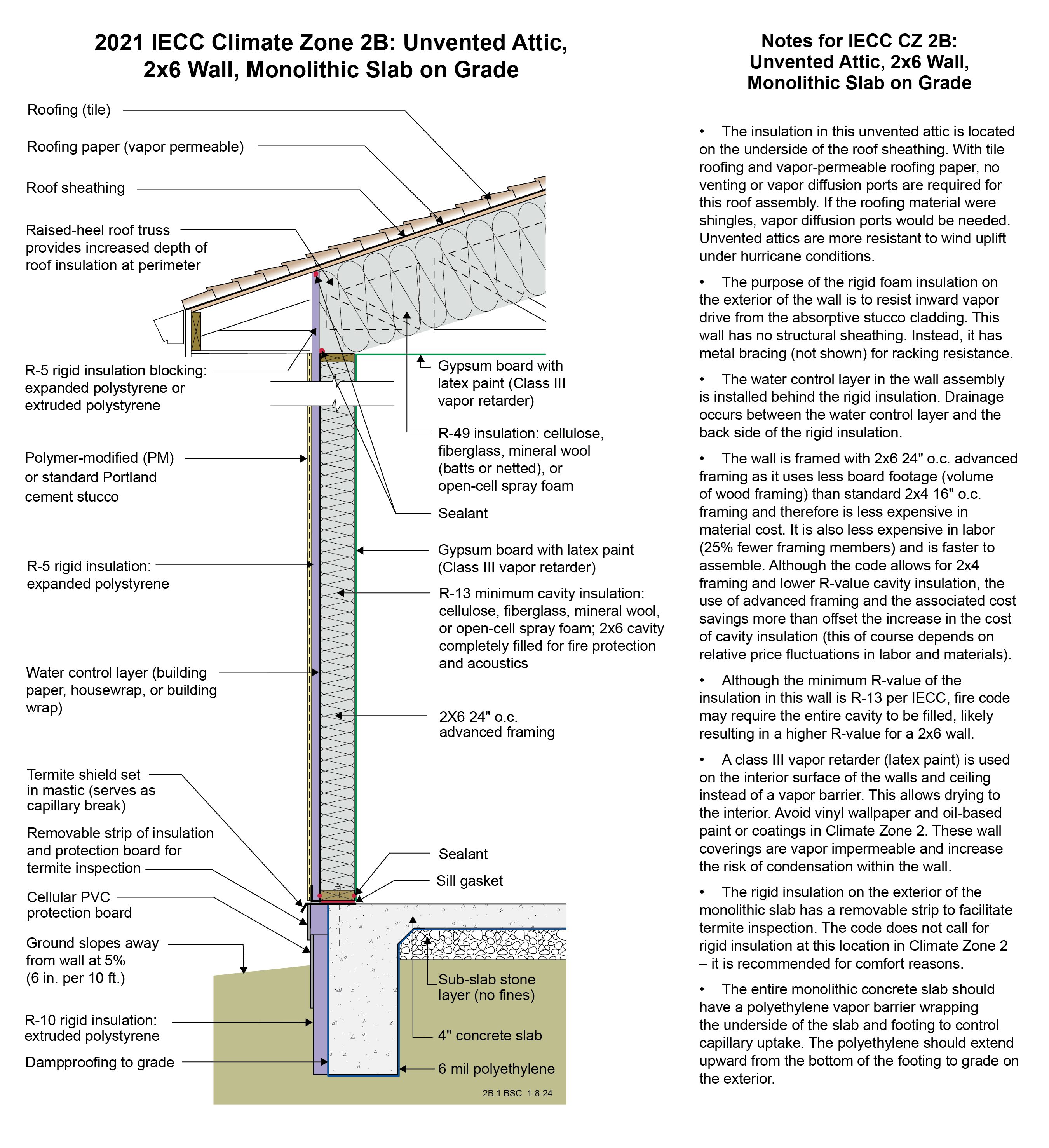
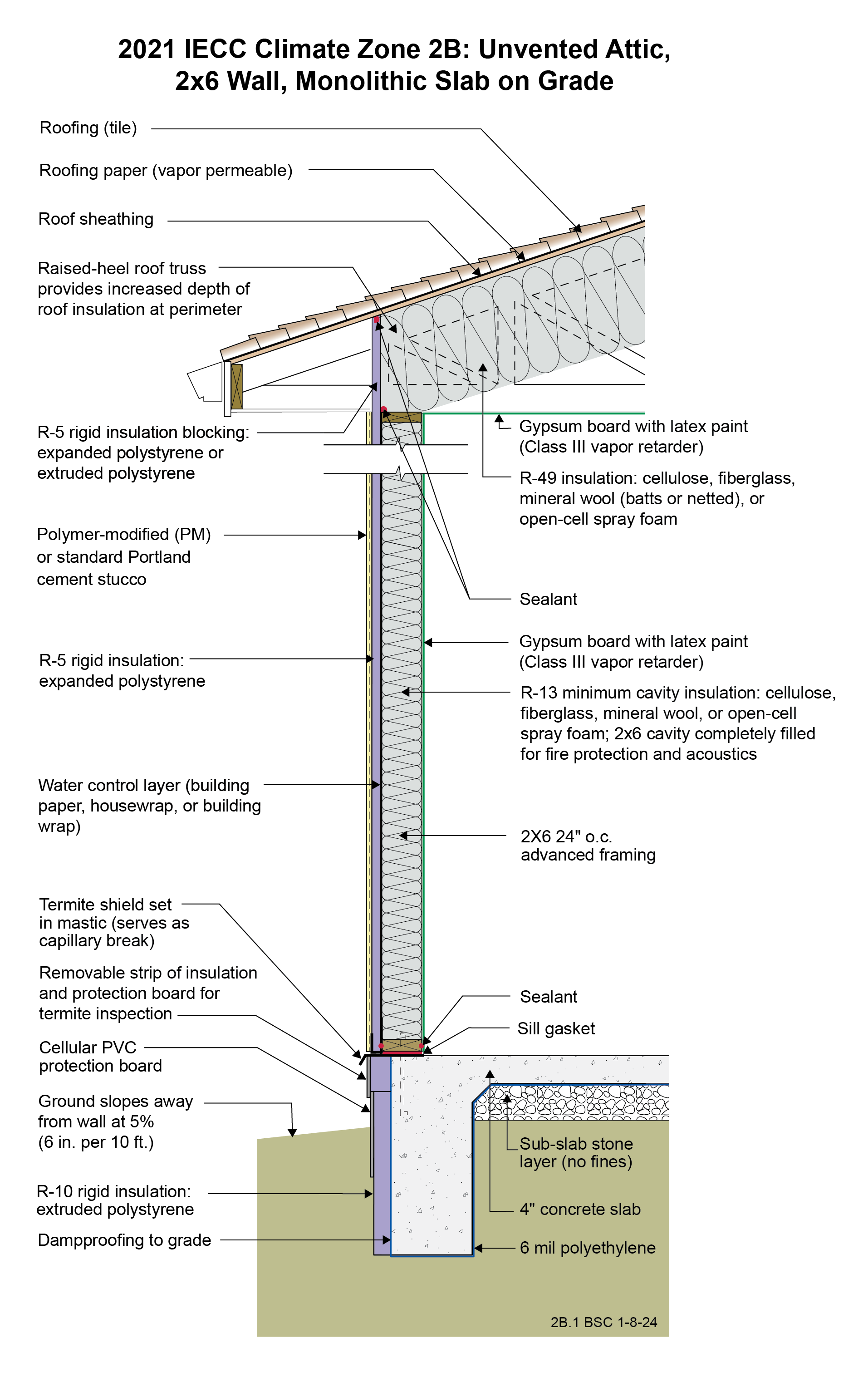
Drawing 2B.1: IECC CZ 2B: Unvented Attic, 2x6 Wall, Monolithic Slab on Grade
- The insulation in this unvented attic is located on the underside of the roof sheathing. With tile roofing and vapor-permeable roofing paper, no venting or vapor diffusion ports are required for this roof assembly. If the roofing material were shingles, vapor diffusion ports would be needed. Unvented attics are more resistant to wind uplift under hurricane conditions.
- If a raised-heel roof truss is used to allow R-38 attic insulation over the full width of the exterior wall, then R-38 can be used throughout the attic rather than R-49. See Section R402.2.1 of the 2021 IECC.
- The purpose of the rigid foam insulation on the exterior of the wall is to resist inward vapor drive from the absorptive stucco cladding. This wall has no structural sheathing. Instead, it has metal bracing (not shown) for racking resistance.
- The water control layer in the wall assembly is installed behind the rigid insulation. Drainage occurs between the water control layer and the back side of the rigid insulation.
- The wall is framed with 2x6 24” o.c. advanced framing as it uses less board footage (volume of wood framing) than standard 2x4 16” o.c. framing and therefore is less expensive in material cost. It is also less expensive in labor (25% fewer framing members) and is faster to assemble. Although the code allows for 2x4 framing and lower R-value cavity insulation, the use of advanced framing and the associated cost savings more than offset the increase in the cost of cavity insulation (this of course depends on relative price fluctuations in labor and materials).
- Although the minimum R-value of the insulation in this wall is R-13 per IECC, fire code may require the entire cavity to be filled, likely resulting in a higher R-value for a 2x6 wall.
- A class III vapor retarder (latex paint) is used on the interior surface of the walls and ceiling instead of a vapor barrier. This allows drying to the interior. Avoid vinyl wallpaper and oil-based paint or coatings in Climate Zone 2. These wall coverings are vapor impermeable and increase the risk of condensation within the wall.
- The rigid insulation on the exterior of the monolithic slab has a removable strip to facilitate termite inspection. The code does not call for rigid insulation at this location in Climate Zone 2 – it is recommended for comfort reasons.
- The entire monolithic concrete slab should have a polyethylene vapor barrier wrapping the underside of the slab and footing to control capillary uptake. The polyethylene should extend upward from the bottom of the footing to grade on the exterior.
Drawing + notes (portrait pdf)
(553.23 KB)
Drawing + notes (tabloid pdf)
(503.02 KB)
Drawing image + notes (png)
(793 KB)