



Introduction
Door sweeps are a type of metal weatherstripping that is installed at the bottom of exterior doors to prevent air infiltration, reduce drafts, increase the durability of the door, and reduce pest intrusion.
Why
Exterior doorways are essentially large holes in the exterior shell of the home connecting the indoors to the outdoors or to other unconditioned spaces like garages, attics, and porches. Doors adjacent to unconditioned spaces should be treated as exterior doors. With proper installation and air-sealing, exterior doors do not have to represent a significant source of air leakage and heat loss. When installed correctly, door sweeps can provide a robust barrier at the bottom of doors, preventing air, wind, rain, pest, and dust infiltration.
What You'll Need
- Tape Measure
- Door sweep
- Level
- Hack Saw
- Utility Knife
- Drill
1. Select a new door sweep.
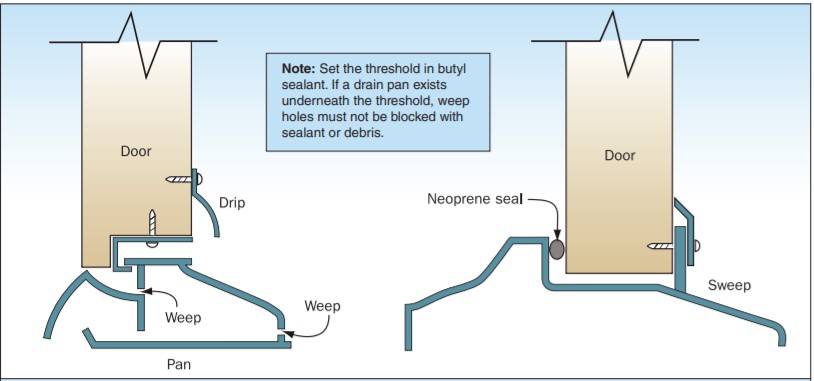
First, identify the type of door sweep you’d like to install. There are aluminum sweeps, rubber sweeps, brush sweeps, sweeps that snap into kerfs cut in the bottom of the door, vinyl sweeps that have an adhesive strip to attach along the bottom on one side of the door, metal sweeps that screw into the bottom of the door, aluminum and vinyl sweeps that are screwed into one side along the bottom of the door, and sweeps that wrap around the bottom of the door. Figures 1 and 2 show a variety of door sweeps. If you are replacing a sweep, you may want to replace it with the same type of sweep you had before or you may want to upgrade to a more durable sweep if the door gets a lot of use or you are also trying to keep out rodents. Make sure the sweep you purchase will work with the thickness of your door.

Source
Article describing the process of adding weatherstripping to and weatherizing old doors.
Source
Report containing 37 fact sheets that provide technical guidance and recommendations concerning the construction of coastal residential buildings.
2. Remove old door sweep.
- If there is already an old door sweep, remove the old sweep.
- Unscrew mounting screws if there are any.
- If the sweep snaps into a kerf cut into the bottom of the door, it can likely be pried out with a flat-head screwdriver or small pry bar. I
- f the old door sweep uses adhesive, carefully pull the sweep away from the door. If the adhesive is very stubborn, you may try warming it with a blow dryer first.
- If there is no existing door sweep, proceed to the next step.
3. Measure door width.
Measure the width of the bottom edge of the door, where the door sweep will be installed (Figure 3). Measure the full width of the door. Gaps at either end could encourage rodent entry.

Source
4. Cut door sweep.
Using a hacksaw, cut the new door sweep, if necessary, to the required size. To get a clean cut, stop sawing when you reach the vinyl insert. Cut the vinyl part of the door sweep with a utility knife or a pair of scissors (Figure 4).

Source
5. Position door sweep.
- Close the door and position the door sweep at the bottom of the door with the bottom vinyl edge touching the door threshold (Figure 5).
- Use a level to ensure the door sweep is even.
- Either use painters tape or have someone else hold the door sweep in place and mark the center of the holes with a pencil. Make sure to mark the center of the hole to allow for future adjustment.

Source
6. Drill pilot holes.
Drill pilot holes at each mark, using a drill bit that is narrower than the screw provided with the door sweep. Ensure that the holes are perpendicular to the door and make sure not to drill through the door itself.
7. Attach the door sweep.
- Attach the door sweep using the provided screws (if needed). Before fully tightening the screws, test the door sweep. The door sweep should allow the door to open and close comfortably without too much resistance but should firmly press the door threshold.
- If needed, adjust the door sweep up or down to make sure that there is no gap between the bottom of the door sweep and the threshold. Ensure the door sweep is level and tighten the screws fully. Take care not to strip out the screws in case later adjustments are needed.