An official website of the United States government
Here's how you know
Official websites use .gov
A .gov website belongs to an official government organization in the United States.
Secure .gov websites use HTTPS
A lock (
) or https:// means you’ve safely connected to the .gov website. Share sensitive information only on official, secure websites.
Checklist providing prescriptive instructions on how to retrofit ladder framing on gable end overhangs to achieve a maximum depth of 18 in. from the face of the wall.
Checklist highlighting key concepts of wind design uplift pressures and design uplift pressure ratings for proper selection and installation of residential roof covering systems to comply with section R905.1 of the 2015 International Residential Code for a FORTIFIED Roof™–New Roof designation.
A Recovery Advisory guide reccomending practices for designing and installing metal roof systems that will enhance wind resistance in high-wind regions (i.e., greater than 90-miles per hour [mph] gust design wind speed).
Fact sheet describing proper roof sheathing installation and illustrating fastening methods that will enhance the durability of a building in high-wind areas; also published in FEMA P-499 “Home Builder’s Guide to Coastal Construction: Technical Fact Sheet Series.”
Fact sheet describing the importance of proper roof and deck flashing, and typical and enhanced flashing techniques for coastal homes; also published in FEMA P-499 “Home Builder’s Guide to Coastal Construction: Technical Fact Sheet Series.”
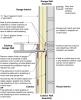
A structural insulated panel (SIP) roof has no embedded lumber in the structure, and therefore nothing substantial for attaching PV array and solar hot water mounts. Single or double lumber splines could be put into the panels, or I-joists at 4-foot intervals could be added.
Article from RMI on how climate change is leading to an increase in critical extreme heat hours and what smart building strategies can be taken to mitigate some of these effects including paint color and insulation.
Large scale simulation study investigating the effects of cool roofs and walls on buildings of various vintages across the U.S., with special attention given to California.
Checklist describing requirements for roof sheathing along the gable end truss or rafter to achive a FORTIFIED Roof, including New Roof designations and exceptions.
Computer simulations comparing International Journal of Advanced Structural Engineering wind pressure differences between a gable-ended roof versus a hip roof versus a pyramidal-shaped roof.
Guide to retrofitting or strengthening gable end walls to reduce chances that the wall will be damaged in a hurricane per IBHS Fortified Home practices.
Manuals describing design, materials, and installation techniques applicable to almost all types of roof systems; four-volume set includes Metal Panel and SPF Roof Systems, Membrane Roof Systems, Architectural Metal Flashing and Condensation and Air Leakage Control, and Steep-Slope Roof Systems.
Article describing ways to protect roofs from water infiltration by using self-adhering underlayment in vulnerable locations such as roof valleys, eave edges (to help deal with ice dams), rake edges, roofs to vertical walls (such as dormers), sidewall protection, the bottom of dormer valleys, and...
Checklist providing selection and installation guidance for residential, non-structural metal roof systems installed over wood roof decks with a roof slope 2:12 or greater to comply with section R905.1 of the 2015 IRC for a FORTIFIED Roof – New Roof Designation.